

In today’s volatile and technology-driven economy, organizations are no longer competing solely on products, platforms, or pricing. They are competing on culture, leadership depth, talent agility, and organizational resilience. The enterprises that will dominate the next decade are those that understand one fundamental truth: people strategy is business strategy.
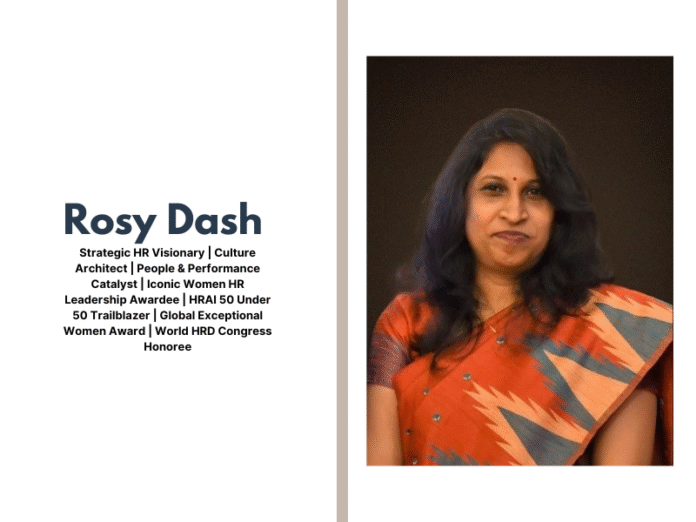
At the forefront of this evolution stands a transformational HR leader whose career spans more than two decades across IT, telecom, fintech, ITES and BPM, GIS and CAD, infrastructure, mineral trading, microfinance, and NBFC sectors. Her journey is not defined merely by roles or titles, but by her ability to align human capital architecture with enterprise ambition.
Currently serving as AGM – Human Resources at AABSyS IT, she represents a new generation of global people leaders who view HR not as a support function, but as a core driver of value creation, operational stability, and scalable growth.
“HR is not a cost center. It is the engine that powers sustainable growth when built with strategic intent.”
Engineering Talent Strategy for Enterprise Growth
With over 21 years of cross-industry exposure, she has partnered with founders, executive boards, and global leadership teams to design people ecosystems that enable transformation at scale. Her work has consistently bridged the gap between business acceleration and workforce enablement.
Her academic foundation, an MBA from the Institute of Public Enterprise Hyderabad. A Law degree from Utkal University, and a Bachelor’s degree in Agriculture from OUAT, equips her with analytical discipline, regulatory insight, and operational clarity. This multidisciplinary lens allows her to view human capital not in isolation, but as part of a broader business architecture.
Her approach integrates four critical pillars:
• Strategic workforce planning aligned to market expansion
• Leadership capability development for long-term sustainability
• Culture design for performance and inclusion
• Data-driven HR governance to enhance accountability
This blend of structure and empathy defines her leadership philosophy.
Building from Ground Zero: Scaling Without Compromising Culture
One of her most defining professional chapters began when she joined a startup with just five employees and no formal HR framework. The organization was ambitious but structurally unprepared for scale.
Within two years, the workforce expanded to over 100 employees. More importantly, attrition reduced by over 35 percent in the first year.
This transformation was not driven by aggressive hiring alone. It was driven by disciplined system-building:
She implemented structured recruitment processes, introduced a robust HRIS, formalized performance management systems, established transparent appraisal frameworks, and launched leadership and engagement initiatives designed to embed accountability without diminishing trust.
“Scaling headcount is easy. Scaling culture is leadership.”
By prioritizing onboarding quality, manager training, and communication clarity, she ensured that rapid growth did not dilute organizational values. This experience reinforced her conviction that sustainable growth is not accidental, it is architected.
Cultural Transformation Through Intentional Leadership
Across sectors and geographies, she has led initiatives where digital acceleration often outpaced organizational readiness. In these environments, resistance to change is common, and alignment becomes fragile.
Her response has always been deliberate. Rather than imposing transformation, she co-creates it.
By clearly communicating the “why” behind initiatives and inviting stakeholder participation early, she fosters ownership. Quick wins are strategically combined with long-term system reform, ensuring that momentum and structural resilience evolve simultaneously.
She believes high-performance cultures are built on three non-negotiables: clarity, consistency, and credibility.
“Culture is not defined by policy documents. It is defined by daily leadership behavior.”
This philosophy has enabled her to navigate complex regulatory environments, multi-generational teams, and geographically distributed operations while maintaining engagement and performance continuity.
Recognition as a Global People Leader
Her impact has been widely recognized across national and international platforms. She has been honored with the Iconic Women HR Leadership Award, named among the HRAI 50 Under 50 Trailblazers, awarded the Global Exceptional Women Award, and recognized among the Top HR Leaders in Odisha by the World HRD Congress. Business Fame has also featured her among India’s Most Influential HR Leaders to Follow in 2025.
While these accolades reflect industry acknowledgment, her focus remains firmly on enterprise value and societal contribution rather than recognition.
HR in the Age of Digital Acceleration
As artificial intelligence, automation, and hybrid work redefine global business norms, she views the HR function as a stabilizing and future-shaping force.
Organizations today must not only digitize processes but also humanize transformation. Technology without engagement fails. Strategy without emotional intelligence fractures.
She advocates for predictive analytics in workforce planning, AI-enabled talent acquisition, and digital performance dashboards, but always anchored in ethical governance and human sensitivity.
In her perspective, the next five years will demand leaders who can integrate digital fluency with emotional intelligence.
“The future of work will not belong to the most automated organizations. It will belong to the most adaptable ones.”
A Global Perspective on Regional Impact
Operating in India while engaging with global business ecosystems, she embodies a regionally rooted yet globally oriented leadership approach. Emerging markets, particularly in South Asia, are witnessing unprecedented digital and industrial growth. However, scaling responsibly requires leaders who can align talent strategies with regulatory realities, demographic shifts, and economic volatility.
Her experience across manufacturing, fintech, and technology sectors positions her to understand both emerging market complexities and global competitiveness requirements.
By aligning HR frameworks with long-term enterprise strategy, she ensures that organizations are not just operationally efficient but globally credible.
Developing the Next Generation of Leaders
Beyond enterprise transformation, she is deeply invested in mentorship and leadership development. She believes succession planning must evolve into capability architecture, where organizations intentionally build cross-functional exposure, resilience, and ethical judgment into their future leaders.
Her advice to aspiring executives is grounded and pragmatic.
“Start where you are. Add value before you ask for authority. Leadership begins long before designation.”
She encourages young professionals to cultivate curiosity, adaptability, and disciplined execution while maintaining authenticity and humility.
Defining Success in the Modern Enterprise
For her, success has evolved over time. Early career milestones focused on performance metrics and upward mobility. Today, success is defined by impact, influence, and the ability to create systems that outlast individual tenure.
True leadership, she believes, is measured by the strength of the organization after you step away from it.
Her work demonstrates that people strategy, when executed with strategic discipline and human depth, becomes a multiplier for enterprise value.
The Road Ahead
As organizations globally confront economic volatility, digital disruption, and talent scarcity, leaders who can integrate operational excellence with human-centric strategy will define the future.
Her vision is clear: build organizations where performance and purpose coexist, where technology accelerates but does not overshadow humanity, and where growth is engineered through culture.
In 2026 and beyond, as global enterprises recalibrate for resilience and innovation, leaders like her are not simply responding to change—they are designing it.