
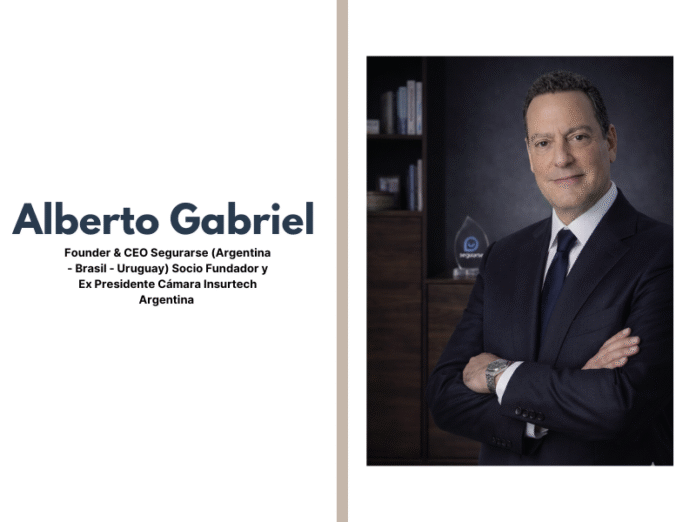

For more than two decades, Alberto Gabriel has operated at the intersection of volatility, regulation, and human trust, three forces that define Latin America’s financial and insurance landscapes. Today, as President and CEO of AG Global Services, his leadership represents something larger than operational success, a long-term vision to democratize insurance and redefine its social role in the region.
Alberto’s career has never followed a predictable trajectory. It has been shaped instead by disruption, economic, institutional, and technological, that forced constant reinvention. These moments did not merely influence how he leads companies, they reshaped his understanding of what insurance must become in societies where uncertainty is not episodic, but structural.
One of the most formative moments came during the Argentine financial crisis of 2001. As institutions collapsed and public confidence eroded, Alberto witnessed firsthand how fragile trusted systems could be when transparency disappears. The experience left him with a conviction that would guide every decision that followed, in unstable economies, adaptability is not a competitive advantage, it is a moral imperative. Insurance, at its core, must function as a credible promise, especially when everything else fails.
That belief found its most tangible expression a decade later, in 2011, with the founding of Segurarse.com.ar. At the time, digital insurance in Latin America was widely dismissed as impractical. Information asymmetry favored intermediaries, pricing was opaque, and customers were conditioned to accept complexity as inevitable. Alberto challenged that assumption, not by introducing a new tool, but by changing the balance of power.
“The issue was never a lack of demand,” he has said. “It was a lack of agency.”
By opening access to real-time information and comparable options, Segurarse helped dismantle a system where consumers were dependent on intermediaries to understand products that directly affected their financial security. For the first time, a household in Mendoza could make informed decisions with the same clarity as a corporate executive in Buenos Aires. This was not simply digitalization, it was democratization. By expanding informed participation, the platform contributed to broader risk pools, lower systemic costs, and a more inclusive insurance ecosystem.
As the model expanded into Brazil and Uruguay, Alberto’s leadership philosophy became even clearer. Scaling was never about imposing uniformity. Each market demanded cultural fluency and regulatory respect. Brazilian customers normalized installment payments. Argentine consumers, shaped by inflationary cycles, resisted long-term commitments. Uruguay prioritized predictability and institutional stability. Technology was the enabler, but empathy was the differentiator.
Equally complex was the relationship with traditional insurers. Early skepticism framed digital platforms as existential threats. Alberto chose a different path, one rooted in partnership rather than disruption for its own sake. Over time, he demonstrated that innovation could strengthen incumbents instead of displacing them, aligning regulatory rigor with customer-centric speed. Approval, he learned, was not the finish line. Trust was.
This philosophy scaled beyond individual companies with the founding of the Cámara Insurtech Argentina. What began as a small group of founders articulating a shared vision evolved into an ecosystem representing approximately 65 percent of Argentina’s insurance market. Yet for Alberto, the achievement was never about dominance.
“Leadership isn’t about winning rooms,” he often notes. “It’s about building rooms where collaboration becomes inevitable.”
Through the Chamber, Alberto did more than advocate for innovation. He helped redefine the industry’s social contract, positioning insurtech not as a challenger to regulation, but as its modern ally. The result was an environment where startups, insurers, regulators, and technology providers could co-create rather than compete in isolation.
Today, Alberto views Latin America’s insurtech sector as mature, but incomplete. Capital flows and regulatory frameworks have improved, yet vast segments of the informal economy remain uninsured. For him, this gap represents both a structural failure and a generational opportunity. True innovation, he believes, lies not in marginal efficiency gains, but in designing systems that bring financial protection to those historically excluded from it.
At AG Global Services, this philosophy governs a diverse portfolio spanning insurance solutions, consulting, financial services, and technology ventures. Alignment across such breadth is achieved through a principle that is deliberately uncompromising, trust precedes scale. Innovation must enhance credibility, and profitability must confirm that trust has been earned, not extracted.
Transparency, in Alberto’s view, is not a messaging strategy, it is an architecture. Customers are shown not only prices, but the logic behind them. Exclusions are clarified before purchase, not during claims. Renewal conversations include honest assessments, even when switching providers may be the better outcome. These moments, particularly under stress, are where insurance proves whether it is a promise or merely a product.
His leadership style reflects this same clarity. In startups, he leads through inquiry, rapid testing, and intellectual humility. In established organizations, leadership becomes an exercise in alignment, bridging legacy structures with future realities. Across both, one principle remains constant, saying “I don’t know” early protects credibility later.
Looking ahead, Alberto sees insurance undergoing a fundamental shift, from reactive compensation to proactive prevention. Data and AI are transforming underwriting, risk assessment, and customer engagement. Embedded insurance will redefine distribution, while AI-augmented advisors will reshape complex decision-making. Automation will handle simplicity, human judgment will remain essential where stakes are highest.
For entrepreneurs entering regulated industries, his guidance is pragmatic and counterintuitive. Regulation, he argues, is not an obstacle but a competitive moat. Mastery of compliance creates barriers technology alone cannot replicate. The future belongs to those who partner with incumbents, combining licenses and capital with speed, insight, and ethical design.
When asked about legacy, Alberto’s ambition extends beyond any single venture. He wants Latin America to export insurance innovation, not import it. The region’s economic volatility has forced solutions with global relevance. By building bridges between ecosystems and markets, he aims to make insurance innovation both credible and aspirational on the world stage.
“Insurance is a promise,” Alberto reflects. “Making that promise accessible, transparent, and trustworthy for millions who have never had it, that’s the legacy worth building.”
In an industry often described as conservative, Alberto Gabriel continues to demonstrate that meaningful transformation is possible when leadership places people, trust, and long-term value at the center of innovation.