
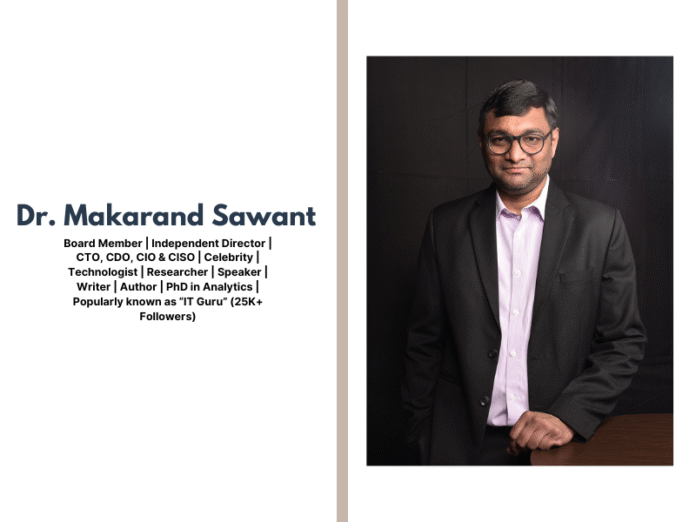

In an era where technology is no longer a support function but the backbone of global enterprise, leaders like Dr. Makarand Sawant stand at the intersection of innovation, responsibility, and long-term value creation. With more than two decades spanning digital transformation, analytics, cybersecurity, governance, and enterprise IT, his career reflects a rare balance of technical depth and strategic foresight, one that places people, sustainability, and resilience at the center of progress.
Dr. Sawant’s journey has never been about chasing technology for its own sake. It has been about using technology to solve real-world business challenges with precision, consistency, and accountability. Early in his career, working closely with operational systems and enterprise decision-makers, he recognized a recurring pattern: organizations struggled not because they lacked tools, but because they lacked alignment between technology, risk, and purpose.
“Technology only creates value when it enhances accuracy, efficiency, and consistency in decision-making,” he reflects. “Once that foundation is in place, organizations can begin to envision the future rather than simply react to it.”
This philosophy shaped his evolution from execution-focused technology leadership into a broader role as a board-level advisor, independent director, and strategic architect for organizations navigating complexity across manufacturing, healthcare, agriculture, and biotechnology.
From Technology Execution to Boardroom Foresight
Dr. Sawant’s leadership distinguishes itself through perspective. As a CIO, CTO, CDO, and CISO, his responsibility has been to deliver systems that work, integrate, and scale. As a Board Member and Independent Director, his responsibility shifts toward foresight, risk anticipation, and organizational resilience.
At the board level, he approaches strategy through Business Impact Analysis rather than narrow technical metrics. Evaluating supply chains, energy consumption, operational dependencies, and governance frameworks allows leadership teams to understand not only how systems perform, but how organizations survive disruption.
This boardroom lens reinforces his belief that digital leadership cannot exist in isolation. Technology, governance, and risk management are inseparable. Enterprise IT architecture, cybersecurity, and GRC frameworks are not constraints on innovation, they are the conditions that make sustainable innovation possible.
“Innovation without governance is fragile,” he often emphasizes. “Strong architecture allows organizations to move fast without losing control.”
Technology as a Driver of the Triple Bottom Line
One of the defining pillars of Dr. Sawant’s leadership is his commitment to the Triple Bottom Line framework of people, planet, and profit. For him, sustainability is not a reporting exercise. It is a design principle.
He advocates for embedding environmental, social, and financial objectives directly into enterprise digital strategy. By using technology to integrate ESG, CSR, and corporate governance initiatives into core business operations, organizations move beyond compliance toward resilience and long-term relevance.
“Businesses that look beyond short-term profit attract better talent, stronger customer trust, and lasting performance,” he explains. “Technology is the integrator that makes this possible.”
His work consistently demonstrates that AI-enabled platforms, real-time dashboards, and integrated analytics can transform sustainability from an abstract goal into a measurable, manageable enterprise function.
Turning Data Into Decisions That Matter
Across his research and enterprise implementations, Dr. Sawant has focused on one central question: how does data translate into real business value? His answer lies in the convergence of analytics, AI, machine learning, Industry 4.0, and automation, deployed not as isolated tools but as unified decision ecosystems.
By implementing centralized real-time dashboards for management and operations, he has enabled leadership teams to make informed decisions with clarity and speed. Integrating IT and OT systems has further driven process excellence, improving productivity, quality, and accuracy across complex environments.
“The purpose of analytics is not reporting,” he notes. “It is intelligent decision support that improves how organizations operate every day.”
This approach has been particularly impactful in manufacturing and healthcare, where smart factories, digital twins, IoT, and automation platforms are redefining efficiency, safety, and scalability.
Leading Transformation Through Change, Not Resistance
Despite technological advancement, Dr. Sawant observes that the greatest barriers to transformation remain human and cultural. Legacy systems, entrenched processes, and resistance to change can undermine even the most advanced digital initiatives.
His response has always been rooted in structured change management and continuous upskilling. Rather than replacing people, he focuses on enabling them. Upskilling existing talent, aligning leadership intent, and communicating purpose clearly ensures transformation is embraced rather than resisted.
“Transformation succeeds when people grow with the technology,” he says. “Not when they feel displaced by it.”
This people-centric approach has allowed him to lead complex transformations across brownfield and greenfield projects, as well as during mergers and acquisitions where IT due diligence becomes a decisive factor in long-term success.
Cybersecurity, Risk, and the Ethics of Innovation
In today’s digital economy, cybersecurity and governance are no longer defensive functions. They are strategic enablers. Dr. Sawant views risk management, GRC frameworks, and cybersecurity architecture as ethical responsibilities, not technical checklists.
By placing these foundations at the core of digital initiatives, organizations gain the confidence to innovate responsibly. This balance between agility and control defines his approach to leadership in regulated and high-impact environments.
“Risk management is not about slowing innovation,” he explains. “It is about ensuring innovation remains trustworthy.”
The Future of Technology Leadership
Looking ahead, Dr. Sawant believes the next wave of disruption will come from AI-enabled platforms that unify digital transformation, automation, ESG, CSR, and governance into a single, intelligent management layer. These systems will not only monitor performance but actively guide leadership decisions in real time.
For future CIOs and digital leaders, technical knowledge alone will not be enough. Deep understanding of business context, sustainability, and ethical responsibility will define relevance.
“Continuous learning is no longer optional,” he states. “Upskilling is the only way leaders remain relevant in an ever-evolving technology landscape.”
As an author, researcher, speaker, and thought leader, Dr. Sawant continues to share knowledge not to build personal authority, but to elevate the profession. His teaching philosophy is grounded in real-world experience, ensuring future leaders understand both the power and responsibility of technology.
A Vision Rooted in People and Purpose
At the heart of Dr. Makarand Sawant’s leadership is a clear vision: technology leaders must shape organizations that are sustainable, resilient, and deeply human. By implementing solutions that enhance transparency, monitor progress, and align purpose with performance, he believes technology can become the most powerful force for responsible growth.
His career stands as a reminder that true digital leadership is not defined by systems deployed, but by trust built, people empowered, and futures safeguarded.
In a world increasingly driven by algorithms and automation, leaders like Dr. Sawant ensure that intelligence remains guided by ethics, foresight, and human intent.