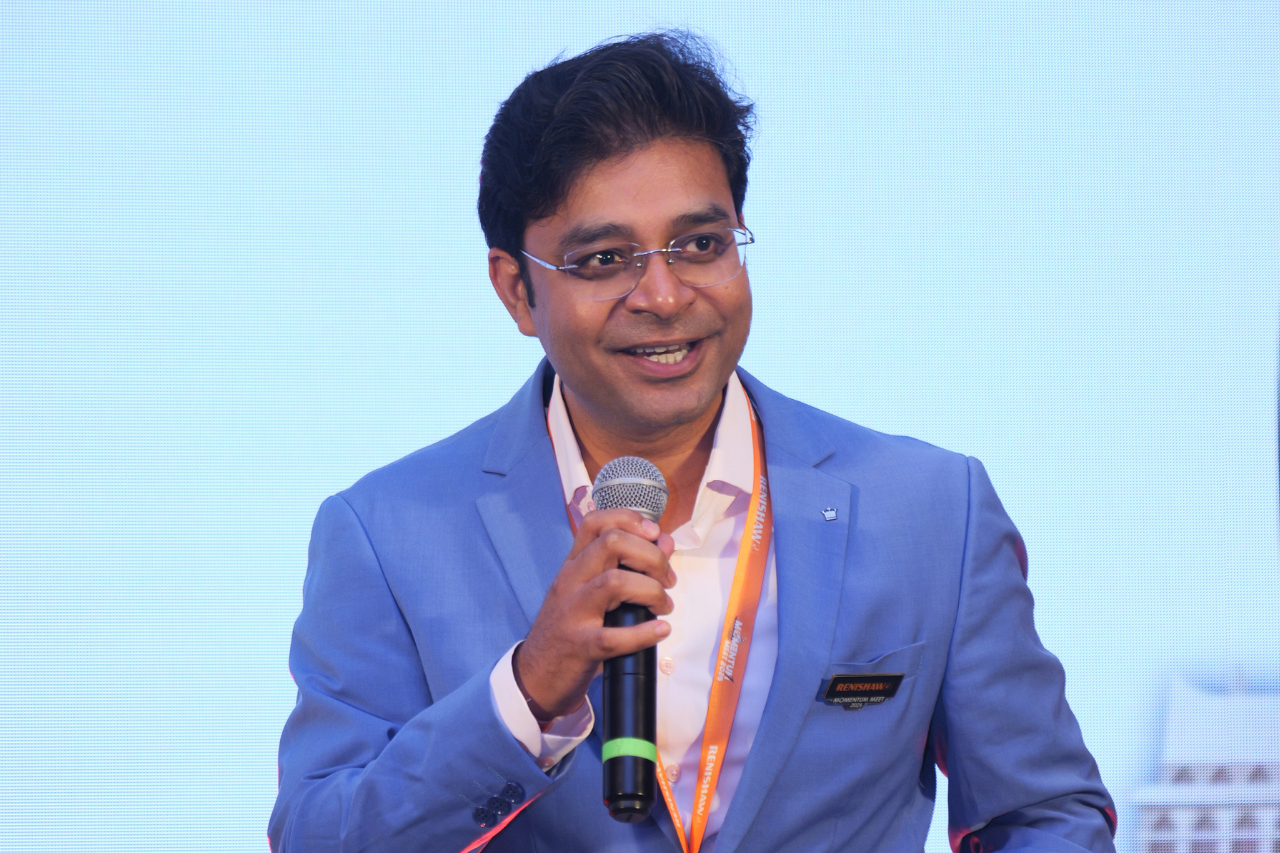
Where Engineering Meets Purpose
Every era of industrial progress is remembered not only for the technologies that transformed manufacturing but also for the leaders who reimagined how those technologies could create lasting value. While machines become faster, factories become smarter, and digital technologies continue to redefine industrial operations, true transformation has always depended on people—leaders who possess the vision to look beyond immediate challenges and the conviction to build systems that stand the test of time. Among those shaping India's evolving manufacturing landscape is Dr. Sanjeev Kumar, whose professional journey represents a unique convergence of engineering excellence, academic research, strategic business leadership, and an unwavering commitment to industrial transformation. As Deputy Director – Business Development and Services at Renishaw India, he has spent more than two decades working alongside manufacturers across diverse industries, helping them strengthen process capability, improve precision, and embrace smarter manufacturing practices that enhance both operational efficiency and long-term competitiveness.
What makes his journey particularly compelling is that it has never been driven by technology alone. Throughout his career, Dr. Kumar has consistently viewed innovation as a means rather than an end. For him, the true value of any technological advancement lies not in its sophistication but in its ability to solve practical problems, reduce uncertainty, and create measurable improvements for customers. This belief has shaped his leadership philosophy and continues to influence the way he approaches every customer engagement, every strategic initiative, and every opportunity to contribute to the future of manufacturing. Today, as industries across the globe embrace artificial intelligence, smart factories, digital twins, automation, and connected manufacturing ecosystems, conversations often revolve around the technologies themselves. Yet Dr. Kumar believes the most important discussion begins much earlier. Before organisations decide which technology to adopt, they must first understand the problem they are trying to solve, the capability they hope to build, and the confidence they seek to create within their people and processes. In his view, sustainable transformation is achieved not by purchasing advanced equipment but by cultivating a culture where technology, engineering discipline, and human capability work together toward a common purpose.
This philosophy has become increasingly relevant as India positions itself as a global manufacturing powerhouse. With ambitious investments across aerospace, defence, electric mobility, electronics, medical devices, and precision engineering, Indian manufacturers are no longer competing solely on cost. They are competing on quality, repeatability, traceability, and the ability to deliver products that consistently meet international standards. Meeting those expectations requires more than modern machinery; it requires visionary leadership, disciplined execution, and an unwavering commitment to continuous improvement. For Dr. Kumar, helping organisations build that capability has become far more than a professional responsibility. It has evolved into a lifelong mission.
A Journey Defined by Curiosity, Learning, and Practical Innovation
Looking back on his career, Dr. Kumar often reflects on three environments that fundamentally shaped the way he thinks about leadership, innovation, and manufacturing excellence. Rather than describing them as milestones, he refers to them as three classrooms that continue to influence his decisions even today, the academic classroom, the research laboratory, and the manufacturing shop floor. His doctoral research at the University of Bath laid the intellectual foundation of his professional journey. Immersed in an environment where every hypothesis required validation and every conclusion had to be supported by evidence, he developed an appreciation for disciplined thinking that continues to define his leadership approach. Research, he explains, teaches patience in a way few other experiences can. It encourages curiosity, rewards persistence, and perhaps most importantly, instils humility. Experiments do not always produce expected results, assumptions are frequently challenged, and progress often comes only after repeated refinement.
These lessons extended far beyond engineering. They shaped a mindset that values evidence over assumption, continuous learning over complacency, and thoughtful problem-solving over quick conclusions. Even today, that scientific discipline influences the way he approaches strategic decisions, customer challenges, and organisational transformation. Yet while academia taught him how to analyse problems, it was the manufacturing floor that taught him why those problems truly mattered. As his career evolved from research into industrial applications and business leadership, Dr. Kumar found himself working closely with manufacturers across India. It was here that engineering theories met commercial realities. He encountered organisations equipped with sophisticated machinery yet struggling to maintain consistent quality. He worked with highly skilled engineers who faced relentless production pressures, entrepreneurs determined to compete globally despite resource constraints, and operators whose years of practical experience often determined whether production targets were achieved.
These experiences revealed a side of manufacturing rarely discussed in technical journals. Behind every finished component lies an intricate balance of process control, measurement accuracy, machine capability, operator expertise, and disciplined execution. A single variation in one stage of production can ripple across an entire manufacturing system, affecting quality, delivery schedules, customer confidence, and ultimately business performance. Witnessing these realities transformed his understanding of innovation.
He realised that even the most sophisticated technology holds little value if it fails to address the challenges manufacturers face every day. An advanced system may appear impressive in theory, but unless it helps reduce scrap, improve repeatability, simplify operations, minimise downtime, or strengthen process capability, its impact remains limited. Technology should never be introduced simply because it represents the latest advancement; it should be implemented because it enables organisations to work smarter, produce more consistently, and compete more effectively. This insight became a defining turning point in his professional journey. Rather than focusing on how advanced a technology might be, he began asking a more meaningful question: How can this solution help customers become more capable tomorrow than they are today? That simple shift in perspective continues to shape every aspect of his leadership.
"Innovation achieves its greatest value not when it introduces something new, but when it helps people solve problems with greater confidence, consistency, and purpose."
Beyond Technology: Understanding the Real Challenge
One of the most significant lessons Dr. Kumar has learned throughout his career emerged from a pattern he observed repeatedly while working with manufacturers from different sectors. Organisations would invest heavily in world-class CNC machines, advanced production systems, and skilled personnel, yet many still struggled to achieve consistent manufacturing outcomes. Initial investigations often focused on the equipment, the materials, or the operators. However, as he and his teams examined these challenges more closely, a different picture began to emerge. The issue was rarely the machine itself. More often, it was the process surrounding it.
Measurements were frequently taken too late in the production cycle, allowing variation to remain unnoticed until defects had already entered the system. Valuable process knowledge often resided with a handful of experienced individuals rather than being embedded within structured systems. Corrective actions were reactive rather than preventive, meaning organisations spent valuable time and resources addressing problems after they had already affected production.
For Dr. Kumar, these recurring observations fundamentally changed the way he viewed business growth. He realised that sustainable success is not created simply by introducing advanced technologies or increasing production capacity. Instead, it emerges when organisations gain confidence in their ability to control processes, understand variation, and make informed decisions based on reliable data. This philosophy aligns closely with Renishaw's long-standing commitment to precision engineering and industrial metrology. Rather than treating measurement as the final stage of manufacturing, the emphasis is on integrating measurement throughout the production process, enabling manufacturers to detect variation earlier, improve repeatability, and build quality into every stage of production.
The distinction is profound. Traditional manufacturing often focuses on identifying defects after they occur. Modern manufacturing seeks to prevent those defects from occurring in the first place. By helping customers transition from reactive quality inspection to proactive process control, Dr. Kumar believes organisations can achieve something far more valuable than improved productivity. They develop confidence in their operations, confidence in their people, and confidence in their ability to compete successfully in increasingly demanding global markets.
For him, that confidence represents the true measure of industrial transformation. It is not simply about producing better components. It is about building better manufacturing organisations.
Leading with Purpose in an Era of Transformation
Every industry experience moment that redefines its future. Manufacturing is living through one of those moments today. Across the world, production facilities are becoming increasingly intelligent, powered by automation, connected systems, artificial intelligence, advanced analytics, and real-time data. Concepts that once belonged to research laboratories, digital twins, predictive maintenance, autonomous inspection, and smart factories, are now becoming practical realities on the shop floor. These developments are transforming not only how products are manufactured but also how businesses compete in a rapidly changing global economy.
Yet amid this technological evolution, Dr. Sanjeev Kumar believes one misconception continues to dominate discussions around digital transformation, the assumption that technology alone is capable of delivering sustainable business success. "Technology is an enabler," he explains. "It provides the capability, but it is people who determine whether that capability is translated into meaningful outcomes. Without the right culture, processes, and leadership, even the most advanced technologies cannot achieve their full potential."
This philosophy has become increasingly central to his work at Renishaw India. Rather than approaching customers with a catalogue of products, his focus has always been on understanding their manufacturing environment first. Every organisation has its own challenges, operational priorities, and strategic ambitions. Consequently, every solution must be designed around those realities rather than around the technology itself. During customer interactions, discussions often begin with questions that appear surprisingly simple. Where does variation occur most frequently? Which production process creates the greatest uncertainty? How is manufacturing data currently being captured and analysed?
What prevents operators from making faster and more confident decisions? By understanding these questions before recommending a solution, Dr. Kumar believes organisations are far more likely to achieve lasting improvements rather than temporary fixes. It is an approach that transforms supplier relationships into strategic partnerships, where both organisations work together toward a common objective, building stronger, more capable manufacturing systems. This customer-centric philosophy has remained one of the defining characteristics of his leadership. Rather than measuring success by the number of systems implemented or technologies deployed, he evaluates success through the confidence customers gain after those solutions become part of their everyday operations. When organisations begin making decisions based on reliable data, when quality becomes predictable rather than reactive, and when teams trust the stability of their own processes, the impact extends far beyond production metrics. It influences culture, strengthens customer relationships, and creates a foundation for sustainable growth.
“Customers rarely remember the specifications of a technology. What they remember is the confidence it gave them to produce better, solve problems faster, and compete more effectively.”
The Leadership Philosophy Behind Sustainable Growth
Leadership within engineering organisations presents a unique challenge. It requires balancing technical excellence with commercial understanding, long-term strategy with day-to-day execution, and innovation with operational discipline. For Dr. Kumar, this balance has never been achieved through authority alone; it is built upon trust, collaboration, and a willingness to continuously learn. Throughout his professional journey, he has remained guided by five principles that influence every decision he makes: integrity, ownership, customer-centricity, continuous learning, and mentorship. While these values may sound familiar, he believes their true significance lies in how consistently they are practiced.
Integrity, in his view, is fundamental to precision engineering. Customers rely on technical experts not only for innovative solutions but also for honest guidance. Building long-term credibility requires transparency, being realistic about what a technology can achieve, acknowledging limitations, and working collaboratively to overcome them. Sustainable relationships are built on trust, and trust is earned through consistency rather than promises. Ownership is equally important. Organisations perform at their best when individuals understand that their contribution extends beyond their immediate responsibilities. Whether an engineer is optimising a manufacturing process, a service specialist is supporting a customer, or a business development professional is identifying new opportunities, every role contributes to the larger objective of helping customers succeed.
This sense of ownership naturally encourages accountability, but it also inspires innovation. When people feel personally invested in outcomes, they are more willing to question existing methods, explore new ideas, and seek continuous improvement. For Dr. Kumar, that mindset creates organisations capable of adapting to change rather than simply reacting to it. Continuous learning forms another cornerstone of his leadership philosophy. Manufacturing technologies evolve rapidly, and knowledge that was considered cutting-edge only a few years ago may quickly become outdated. Remaining effective therefore requires intellectual curiosity and the humility to continue learning throughout one's career.
He often encourages young professionals to embrace this mindset early. Degrees and technical qualifications provide an essential foundation, but true expertise develops through practical experience, collaboration with industry, and an openness to learning from every project and every challenge. Perhaps most importantly, he believes leadership is measured by the success of others. Developing future leaders, sharing knowledge, and creating opportunities for professional growth represent responsibilities that extend well beyond individual career achievements.
Why Data Is Becoming Manufacturing's Greatest Asset
For decades, manufacturing excellence was associated primarily with machinery, production capacity, and operational efficiency. While these factors remain important, the modern industrial landscape is increasingly being shaped by another resource—data. Every machine, every inspection system, every production line, and every manufacturing process generates valuable information. When captured accurately and interpreted effectively, this information provides insights that help organisations improve quality, optimise performance, predict maintenance requirements, and reduce operational risk. However, Dr. Kumar believes many organisations underestimate one critical reality. Data is only as reliable as the process used to generate it.
This is where precision measurement assumes strategic importance. Accurate measurement is no longer confined to final inspection; it has become the foundation upon which digital manufacturing is built. Artificial intelligence, predictive analytics, and smart automation all depend upon trustworthy process data. If the underlying measurements are inconsistent, every subsequent decision becomes less reliable. Consequently, organisations seeking to embrace Industry 4.0 must first establish robust measurement systems capable of generating consistent, repeatable, and traceable data. Only then can advanced digital technologies deliver meaningful business value. This perspective has reshaped the way Dr. Kumar approaches manufacturing transformation. Rather than viewing measurement as a quality control activity, he sees it as a strategic business capability—one that enables organisations to identify variation before it becomes a problem, improve process stability, and make decisions with greater confidence.
The transition from reactive inspection to proactive process control represents far more than a technical improvement. It reflects a fundamental shift in manufacturing philosophy. Instead of detecting defects after production, organisations begin preventing those defects through better understanding of their processes. The benefits extend beyond improved quality; they reduce waste, strengthen productivity, increase customer satisfaction, and create a culture where continuous improvement becomes part of everyday operations.
Preparing India for the Next Industrial Revolution
India's manufacturing ambitions have never been greater. As global supply chains diversify and demand for high-quality, precision-engineered products continues to grow, the country is emerging as one of the world's most promising manufacturing destinations. From aerospace and defence to medical technology, electronics, electric mobility, renewable energy, and semiconductor manufacturing, opportunities are expanding across virtually every industrial sector. For Dr. Kumar, this transformation represents far more than economic growth. It is an opportunity to redefine how Indian manufacturing is perceived on the global stage. Indian manufacturers have long demonstrated remarkable ingenuity, adaptability, and resilience. The next stage of this journey, however, requires organisations to complement those strengths with greater precision, stronger process capability, digital maturity, and internationally recognised quality standards.
Achieving this vision demands collaboration rather than competition. Technology providers, manufacturers, research institutions, academic organisations, policymakers, and industry associations all have important roles to play in strengthening the manufacturing ecosystem. Innovation thrives when knowledge is shared, practical experience is exchanged, and organisations work together to solve common challenges. This collaborative spirit continues to inspire Dr. Kumar's work. Whether engaging with customers, mentoring professionals, supporting technology adoption, or contributing to broader industry initiatives, his objective remains consistent—to help organisations become more capable, more competitive, and better prepared for the future.
For him, the true measure of progress is not simply the number of advanced technologies introduced into factories. It is the confidence manufacturers gain in their ability to innovate, adapt, and compete successfully in an increasingly demanding global marketplace.
“The future of manufacturing will not belong to those who simply adopt new technologies. It will belong to those who build the capability, discipline, and confidence to use those technologies wisely.”
Developing People Who Drive Progress
If technology forms the backbone of modern manufacturing, people remain its heartbeat. Throughout his professional journey, Dr. Sanjeev Kumar has consistently believed that sustainable industrial transformation is not created by machines alone. It is driven by individuals who possess the curiosity to learn, the discipline to improve, and the courage to embrace change. No matter how advanced manufacturing technologies become, organisations will always depend upon capable professionals who can interpret data, solve complex problems, collaborate across disciplines, and make informed decisions under pressure. This conviction has significantly influenced his approach to leadership.
Rather than viewing leadership as the responsibility of directing teams, Dr. Kumar sees it as the responsibility of enabling people to realise their potential. Every interaction with a colleague, every discussion with a young engineer, and every engagement with a customer represents an opportunity to share knowledge, encourage independent thinking, and develop confidence. He believes that the strongest organisations are those where learning is continuous and where leadership is demonstrated at every level rather than concentrated within a select few individuals. Having worked across research institutions, industrial environments, and customer-facing leadership roles, he understands that technical knowledge alone is not enough to prepare professionals for the realities of manufacturing. Success in today's industrial landscape demands adaptability, communication, collaboration, and an appreciation of how engineering decisions influence broader business outcomes.
For young professionals entering the manufacturing sector, his advice is both practical and timeless. Build a strong technical foundation, but never allow learning to stop there. Spend time on the shop floor. Observe how production systems operate under real conditions. Engage with operators, application engineers, service teams, and customers. Every conversation offers an opportunity to understand manufacturing from a different perspective, and those experiences often become the most valuable lessons of an entire career. He believes that curiosity is one of the most powerful qualities a professional can possess. Technologies will evolve, industries will change, and business priorities will continue to shift, but individuals who remain eager to learn will always find opportunities to grow. For leaders, creating an environment where curiosity is encouraged rather than constrained is one of the greatest investments they can make.
"The most valuable asset an organisation can develop is not a machine or a technology, it is people who never stop learning and who continuously strive to improve themselves and those around them."
Creating a Culture Where Innovation Thrives
Innovation is often associated with breakthrough inventions or revolutionary technologies. While these achievements undoubtedly shape the future, Dr. Kumar believes that genuine innovation is just as often found in the everyday improvements that transform how organisations operate. A manufacturing process becomes more stable because a team identified a source of variation that had previously gone unnoticed. A customer reduces production downtime after implementing a more effective measurement strategy. An engineer discovers a simpler way to improve repeatability, making quality more consistent across multiple production cycles. Individually, these changes may appear incremental, but collectively they create extraordinary impact.
This philosophy reflects the Japanese principle of continuous improvement, small, consistent enhancements that accumulate over time to deliver significant long-term benefits. Throughout his career, Dr. Kumar has encouraged teams to embrace this mindset by fostering a culture where every challenge is viewed as an opportunity to learn rather than an obstacle to overcome. Within such an environment, innovation becomes everyone's responsibility rather than the task of a specialised department. Engineers contribute ideas from technical experience, service professionals identify opportunities through customer interactions, business development teams understand evolving market expectations, and manufacturing specialists apply practical knowledge from the production floor. By bringing together these diverse perspectives, organisations develop solutions that are not only technically sound but also commercially relevant and operationally sustainable.
Equally important is the willingness to learn from setbacks. In engineering and manufacturing, not every initiative produces immediate success. Processes may require refinement, assumptions may need to be revisited, and unexpected challenges often emerge along the way. Rather than viewing these moments as failures, Dr. Kumar encourages teams to treat them as valuable sources of insight. Organisations that openly analyse their experiences and continuously refine their approaches are far more resilient than those that simply repeat established practices. This culture of collaboration, openness, and continuous learning has become one of the defining characteristics of his leadership. It reinforces the belief that innovation is not a destination reached through a single breakthrough, but a journey sustained through countless improvements made every day.
Building an Ecosystem for Manufacturing Excellence
As India advances toward becoming one of the world's leading manufacturing economies, Dr. Kumar believes the country's success will depend on much more than individual organisations achieving commercial growth. Lasting progress requires a strong and interconnected industrial ecosystem where manufacturers, technology providers, educational institutions, research organisations, and policymakers work together to address shared challenges. The complexity of modern manufacturing makes collaboration essential. Whether producing components for aerospace, electric vehicles, medical devices, electronics, or renewable energy systems, organisations rely on extensive supply chains where consistency, precision, and reliability must be maintained across multiple partners. A single weak link can affect the performance of an entire value chain.
Recognising this reality, Dr. Kumar has consistently advocated for greater knowledge sharing and stronger partnerships throughout the manufacturing community. Technology providers bring global expertise and advanced solutions, while manufacturers contribute practical experience gained through years of operating in highly demanding production environments. Academic institutions play a vital role by preparing the next generation of engineers, while research organisations continue pushing the boundaries of innovation. When these stakeholders collaborate, the benefits extend far beyond individual businesses. The entire manufacturing ecosystem becomes stronger, more competitive, and better prepared to respond to emerging opportunities. His own professional journey reflects this belief. Throughout his career, he has worked at the intersection of research, engineering, customer engagement, and business leadership, allowing him to appreciate the unique perspectives each contributes to industrial progress. Rather than viewing these disciplines as separate, he sees them as complementary elements of a larger system working toward a common objective, advancing manufacturing excellence.
This collaborative mindset also aligns with his role as a member of The Industry Insights Global Advisory Board. He views this opportunity not simply as recognition of his professional accomplishments but as a platform to contribute to meaningful conversations about the future of manufacturing, leadership, and innovation. By sharing practical insights drawn from years of industry experience, he hopes to encourage greater dialogue between business leaders, researchers, policymakers, and technology experts who collectively shape the future of global industry.
"The future of manufacturing will be built through collaboration. No single organisation, technology, or individual can transform an industry alone, but together we can create an ecosystem where innovation becomes sustainable and excellence becomes the standard."
A Legacy Measured by Confidence
When accomplished leaders reflect on their careers, discussions often focus on achievements, milestones, or positions held. Dr. Sanjeev Kumar approaches the question of legacy from a different perspective. For him, success has never been defined solely by business growth, technological implementation, or professional recognition. While these outcomes are important, they represent only part of a much larger purpose. What matters most is the lasting confidence created through every customer relationship, every mentoring conversation, every organisational transformation, and every manufacturing challenge successfully addressed. He hopes to be remembered as someone who encouraged organisations to think differently about manufacturing—not as a collection of machines and processes, but as an integrated system where people, technology, and knowledge work together to achieve meaningful results. He hopes young professionals will recognise the importance of continuous learning, experienced engineers will continue sharing their expertise with future generations, and manufacturing leaders will remain committed to building cultures founded on integrity, collaboration, and excellence.
His aspirations extend beyond individual organisations. As India's manufacturing sector continues to evolve, he hopes to contribute to an ecosystem that is globally recognised for precision, innovation, and reliability. In his view, the country's greatest strength lies not only in its engineering talent but also in its ability to combine ingenuity with disciplined execution. By embracing advanced technologies while maintaining a relentless focus on quality and process excellence, Indian manufacturers have an extraordinary opportunity to establish themselves as trusted partners within global supply chains. Ultimately, Dr. Kumar believes leadership is about creating momentum that continues long after one's own direct involvement. The true measure of success is not how much a leader accomplishes personally, but how many people, organisations, and industries become stronger because of the values they leave behind.
Looking Ahead
As manufacturing enters an era defined by artificial intelligence, digital transformation, and increasingly connected production environments, one thing remains certain—technology will continue to evolve. New tools will emerge, processes will become more intelligent, and industries will discover new ways to improve productivity and competitiveness. Yet, despite these remarkable advances, Dr. Sanjeev Kumar remains convinced that the fundamental principles of manufacturing excellence will remain unchanged. Precision, integrity, collaboration, continuous learning, and a commitment to solving real-world problems will continue to distinguish organisations that succeed from those that merely keep pace with change.
His journey demonstrates that meaningful leadership is not about chasing every new trend but about understanding how innovation can be applied with purpose. It is about creating environments where people feel empowered to contribute, where technology supports better decision-making, and where every improvement, however small, strengthens the foundation for future success. As India continues its journey toward becoming a global manufacturing powerhouse, leaders like Dr. Kumar remind us that the future will not be shaped solely by the technologies we adopt. It will be shaped by the people who choose to use those technologies responsibly, collaboratively, and with a clear vision for creating lasting value. In the end, the legacy of a manufacturing leader is not measured by the sophistication of the machines they introduce or the scale of the projects they oversee. It is measured by the confidence they inspire, the knowledge they share, and the positive impact they leave on the organisations, industries, and people whose lives they touch