
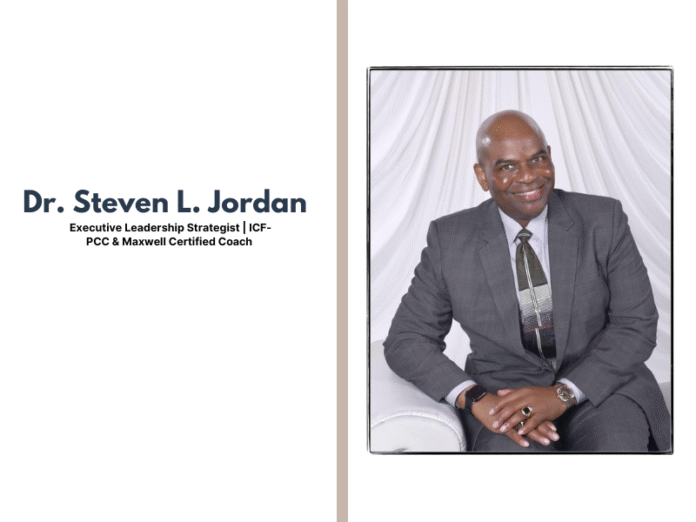

In every era, a few voices rise above the noise—leaders who remind us that true influence is not measured in titles but in transformation. Dr. Steven L. Jordan, Sr., widely known as Dr. J, is one of those voices. With more than three decades of experience spanning the U.S. Army, higher education, healthcare, and executive consulting, Dr. J has built a legacy that bridges courage with compassion, strategy with humanity, and vision with execution.
As an Executive Leadership Strategist, ICF-Professional Certified Coach (PCC), and Maxwell Leadership Certified Trainer, he brings a distinctive blend of military precision, academic depth, and organizational insight to the leaders and institutions he serves. His mission is simple yet profound: to cultivate courageous, conscious, and transformational leadership that endures.
Forged by Experience, Guided by Purpose
Every great leader’s story begins with defining moments—and for Dr. Jordan, three stand out as cornerstones of his philosophy.
The first was forged in the crucible of the U.S. Army, where discipline, adaptability, and resilience became more than values—they became instincts. “The military taught me that leadership isn’t about rank,” he reflects. “It’s about responsibility—taking care of people and delivering the mission no matter the circumstance.”
His second chapter unfolded in higher education, where he served as faculty member, dean, and ultimately university CEO. There, he discovered the transformative power of education and mentorship. “Education changes everything—it creates possibility,” he says. “As a leader, your job is to create the conditions where people discover their potential.”
Finally, the transition into executive coaching and organizational consulting crystalized his purpose: to bridge the gap between strategy and people. Leadership, he realized, fails not because of lack of vision but because of lack of alignment—between intent and execution, values and behavior, mission and morale.
A Philosophy of Transformation
Throughout his career, Dr. Jordan has led across complex sectors—military, academic, governmental, and healthcare—and each shaped his understanding of transformation.
“The military taught me clarity of mission. Academia taught me patience and shared governance. Healthcare reminded me of the power of compassion in performance.”
From those lessons emerged a guiding philosophy: transformation is both systemic and personal. Organizations change only when leaders do. “Real leadership isn’t about control,” he explains. “It’s about creating trust, confronting reality, and unlocking human potential.”
His approach blends operational excellence with empathy—helping organizations move beyond compliance toward genuine engagement. He often reminds executives that “people don’t resist change; they resist being changed without being seen.”
Bridging Strategy and Humanity
One of Dr. Jordan’s core contributions to modern leadership development is his framework for aligning vision with human capacity. He calls it the “Three C’s” model: Clarity, Capacity, and Culture.
Clarity means defining a vision that people can understand, believe in, and act upon.
Capacity involves equipping teams with the right resources and readiness to deliver.
Culture ensures the environment supports accountability, belonging, and resilience.
“Even the most brilliant strategy collapses in a culture of confusion,” he says. Through diagnostic assessments, stakeholder interviews, and one-on-one coaching, he helps organizations translate vision into momentum.
But beyond frameworks, Dr. J emphasizes meaning. “Leaders who connect strategy to personal purpose create movements, not just metrics,” he explains. “When people see themselves in the mission, performance becomes personal.”
Leading Through Complexity
Dr. Jordan’s leadership journey has taken him through corridors of government bureaucracy and the evolving landscape of academia—two environments where innovation often meets resistance.
“Government leadership requires navigating layers of compliance and politics, while academia demands collaboration among fiercely independent thinkers,” he observes. “The key in both is coalition-building—inviting people into the process rather than imposing change.”
In one instance, as a university dean, he led a sweeping institutional transformation by reframing it as a return to mission, not a departure from tradition. “People will embrace change when they see it as a deeper expression of their shared values,” he explains. That approach has since become a hallmark of his consulting work—helping organizations evolve without losing their identity.
Revealing the Blind Spots of Power
In his executive coaching practice, Dr. Jordan works with CEOs, university presidents, healthcare executives, and senior government officials. At that level, he finds that the most dangerous barriers to success are not external—they’re internal.
“C-suite leaders often suffer from overconfidence, isolation, and neglect of culture,” he says. “They focus so intently on numbers and strategy that they forget to ask how people actually feel inside the organization.”
His solution begins with self-awareness. Using tools such as 360-degree feedback, reflective dialogue, and structured coaching, he helps leaders rediscover their impact. “Leadership begins with listening,” he says. “And sometimes, the hardest voice to hear is your own.”
He challenges clients to embrace vulnerability—to admit uncertainty, ask questions, and reconnect with their teams. “Vulnerability isn’t weakness,” he says. “It’s authenticity. And authenticity is what makes leadership human.”
From Academia to Executive Coaching: Bridging Theory and Practice
Dr. Jordan’s background as a scholar and program designer gives him a unique advantage as a coach. He has created and delivered doctoral-level programs in healthcare chaplaincy, leadership, and organizational transformation, blending academic depth with pragmatic application.
“Research gives us frameworks; experience gives us wisdom,” he says. “Coaching brings them together.”
When working with healthcare or corporate leaders, he translates research in organizational psychology and resilience into tangible strategies: How do you sustain your team emotionally during crisis? How do you align values with behavior when pressure mounts?
His coaching philosophy mirrors the educational ideal of the “reflective practitioner”—a leader who acts decisively but also examines the thinking behind each decision. “The goal,” he says, “is to create leaders who think deeply, act boldly, and lead consciously.”
Values that Endure: Discipline, Resilience, and Service
Three words have guided Dr. Jordan since his Army days: Discipline. Resilience. Service.
“Discipline is not rigidity—it’s consistency,” he explains. “Resilience is not merely surviving adversity—it’s growing through it. And service is the highest form of leadership.”
He often tells executives that leadership without service is self-promotion, not transformation. “Power without purpose erodes trust. The most enduring leaders are those who understand that their success is measured by the success of others.”
The Future of Leadership: Purpose, People, and Adaptability
As the pace of change accelerates, Dr. Jordan believes that tomorrow’s leaders must master three core capacities: adaptability, empathy, and systems thinking.
Adaptability allows leaders to pivot amid disruption without losing direction.
Empathy enables them to unify diverse, multigenerational, and global teams.
Systems thinking helps them see interconnections between technology, culture, and sustainability.
“Tomorrow’s leaders must think globally and act humanely,” he says. “They must lead with both IQ and EQ—and increasingly, with CQ: cultural intelligence.”
He also advocates for digital fluency, not as a technical skill but as a strategic mindset. “Technology shapes culture. Leaders who understand that will stay relevant.”
When Culture Becomes the Catalyst
One of Dr. Jordan’s proudest achievements came during a healthcare transformation initiative where morale and retention had plummeted. Through executive coaching, team workshops, and leadership retreats, he guided the organization in closing the gap between stated values and lived behavior.
“Culture is what people do when no one’s watching,” he says. “If you want real change, start with leadership modeling the behavior they expect.”
Within 18 months, the results were undeniable: turnover decreased dramatically, engagement soared, and patient satisfaction reached record levels. “Transformation sticks when leaders become the message,” he reflects. “You can’t coach culture—you must embody it.”
Blending Frameworks and Flexibility
As a Maxwell Leadership Certified Trainer and an ICF PCC coach, Dr. Jordan seamlessly integrates structured frameworks with individualized guidance.
“I see frameworks as scaffolding, not cages,” he explains. “They give structure but leave room for creativity.”
The Maxwell Leadership model emphasizes timeless principles—communication, influence, and growth—while the ICF framework emphasizes deep listening and co-creation. “My role is to discern what a leader needs in the moment—sometimes it’s tools, sometimes it’s reflection, sometimes it’s courage.”
A Legacy of Leadership with Heart
Looking ahead, Dr. Jordan sees leadership moving toward a higher calling: purpose over profit, authenticity over authority.
“What excites me most,” he says, “is that leadership is becoming more human. People no longer follow titles—they follow trust.”
He envisions his role as a bridge-builder—connecting strategy with soul, data with empathy, and performance with purpose. “The next generation of transformative leaders will be those who combine courage with compassion,” he affirms. “That’s the kind of world I want to help shape.”
Leadership as Lifelong Service
When asked about his legacy, Dr. Jordan pauses thoughtfully. “For institutions, I hope to leave cultures that are more inclusive and mission-driven than when I arrived. For leaders, I hope they remember who they became, not just what they achieved.”
His ambition is not about accolades but impact—to inspire leaders who uplift others, transform organizations, and strengthen communities. “If my journey inspires even one leader to lead with integrity and empathy,” he says, “then I’ve done my job.”
A Personal Philosophy: Presence Over Perfection
Among his many stories, one from his early Army days continues to shape his philosophy. As a young officer faced with a critical decision under pressure, he realized his team didn’t need flawless strategy—they needed his calm presence.
“That moment taught me that leadership isn’t about having all the answers,” he recalls. “It’s about being the steady hand when others waver.”
Today, that lesson underpins his entire mission: leadership as transformation—of self, others, and systems. It begins with clarity, matures through courage, and flourishes through compassion.
The Enduring Truth
As our world faces uncertainty and complexity, Dr. Steven L. Jordan, Sr. stands as a living example of what leadership can be when guided by service and soul. His journey reminds us that leadership is not a destination but a discipline—a daily commitment to growth, integrity, and purpose.
“Leaders grow,” he often says, “so that others may flourish.” And in that growth lies his legacy—one of impact, integrity, and hope.