Geneva — October 2025
In a sign of cautious optimism for the global economy, the World Trade Organization (WTO) has upgraded its forecast for global trade growth in 2025, projecting a 2.4% increase in goods trade volume, up from its earlier estimate of just 1.2%. The organization credits improving supply chain resilience, stronger-than-expected consumer demand, and growth in technology-related exports for the revision.
The latest WTO Trade Outlook Report, released this week, suggests that global trade is stabilizing after several years of turbulence caused by the pandemic, geopolitical conflicts, and inflationary shocks. “Trade remains a key engine of global growth, even in the face of structural challenges,” said Ngozi Okonjo-Iweala, Director-General of the WTO. “We are seeing renewed strength in digital goods, green technologies, and supply chain diversification.”
Asia and Technology Lead the Recovery
The report highlights that Asia-Pacific economies—particularly China, India, Vietnam, and South Korea—are leading the rebound, driven by robust exports in semiconductors, electronics, and renewable energy components. The surge in AI and electric vehicle (EV) manufacturing has fueled a spike in global demand for chips and critical materials.
“Technology trade is the lifeblood of the post-pandemic recovery,” noted Dr. Thomas Muller, chief economist at the International Trade Research Institute. “Countries investing in digital and green supply chains are reaping the benefits.”
Meanwhile, European exports are showing modest improvement due to easing inflation and energy price stabilization, while North America’s trade is being buoyed by nearshoring and infrastructure spending under the U.S. Inflation Reduction Act.
Supply Chains Adapt to a New Era
After years of disruption, global supply chains are evolving to become more decentralized and resilient. Companies are diversifying sourcing strategies to reduce dependence on single-country suppliers, especially in critical sectors such as semiconductors, pharmaceuticals, and electric vehicle batteries.
The WTO report notes that “friendshoring” and “regionalization” trends are reshaping trade flows, with production hubs emerging across Southeast Asia, Eastern Europe, and Latin America. However, these shifts also bring new challenges, including higher costs and logistical complexity.
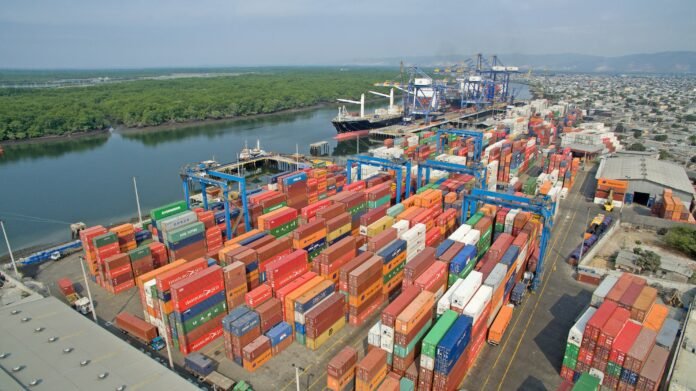
Despite ongoing geopolitical tensions and trade restrictions, container freight rates and shipping times have normalized to pre-pandemic levels. “This normalization signals that the era of extreme supply bottlenecks may finally be behind us,” said Sarah Lin, senior trade analyst at Maersk Global Insights.
A Fragile but Positive Outlook
The WTO emphasized that the trade recovery remains uneven across sectors. Energy and raw materials exports are facing slower growth due to reduced industrial output in Europe and Japan. In contrast, demand for green technologies—such as solar panels, EV batteries, and hydrogen equipment—continues to surge, offsetting weakness in traditional industries.
The organization also warned of potential downside risks, including escalating U.S.–China trade tensions, rising protectionism, and the impact of climate-related disruptions. “Trade resilience is improving, but it is not immune to policy shocks,” said Okonjo-Iweala. “Sustained cooperation and open markets are essential.”
Policy and Investment Implications
Governments worldwide are responding to the shifting trade landscape by implementing policies that support export competitiveness and industrial transformation. India’s “Make in India” initiative and the European Union’s “Global Gateway” program are among several efforts to strengthen supply chain integration and innovation.
Trade analysts believe the upgraded forecast will encourage investors and multinational corporations to re-engage with global markets after a period of uncertainty. “Confidence is returning to the trade ecosystem,” said Ricardo Alvarez, senior strategist at JPMorgan Global Markets. “The focus now is on digital transformation, automation, and sustainable logistics.”
Regional Highlights from the WTO Report
– Asia-Pacific: Expected trade growth of +3.5%, driven by semiconductors and clean energy components.
– Europe: Forecast growth of +1.8%, supported by industrial recovery and consumer goods exports.
– North America: Growth of +2.1%, boosted by nearshoring and infrastructure spending.
– Africa & Middle East: Mixed performance, with oil exporters benefiting from higher energy revenues, while import-dependent nations face inflation pressures.
The Big Picture
Despite headwinds, the WTO’s latest assessment underscores global trade’s resilience and adaptability. As economies increasingly prioritize digitalization, sustainability, and regional cooperation, trade flows are expected to become more balanced and diversified.
“Trade is evolving, not retreating,” said Okonjo-Iweala. “The world is learning to trade smarter — with shorter supply chains, greener logistics, and greater inclusivity.”
With momentum slowly rebuilding, the WTO expects global trade to remain a stabilizing force in the world economy through 2026 and beyond — provided that nations continue to embrace cooperation over confrontation.
Global Trade Growth to Be Stronger Than Expected, Says WTO