
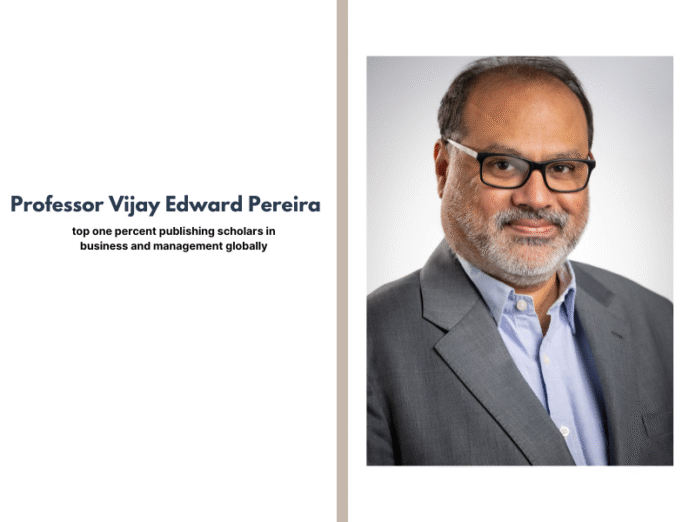

In the evolving landscape of global business and management research, few scholars embody influence, productivity, and purpose as comprehensively as Professor Vijay Edward Pereira. Recognised among the top one percent publishing scholars in business and management globally, he has established a reputation for research that travels across geographies, industries, and policy spaces. What sets him apart is not only the scale of his output, but the philosophy that underpins it, a belief that knowledge must serve society, guide organisations, and shape future leaders.
For more than two decades, Professor Pereira’s work has bridged the Global North and South, academic research and real practice, policy priorities and lived organisational realities. His intellectual mission is grounded in a simple yet powerful idea: Scholarship achieves true value only when it creates meaningful, measurable, real-world impact. Through his research, editorial leadership, global institutional roles, and his London-based centre- Growth, Productivity & Entrepreneurship Centre of eXcellence (GPEC-X), he is rewriting the definition of what it means to be a modern management scholar, practitioner, and thought leader.
A Career Built on Global Experience, Cross-Cultural Understanding, and Interdisciplinary Curiosity
Professor Pereira’s journey reflects a lifetime of international immersion. He has lived, researched, and taught across Europe, India, the Middle East, and the Pacific, which has shaped his unique ability to see business and management challenges through economic, socio-cultural, historical, and political lenses. This multidisciplinary perspective allows him to support governments, multinational corporations, and emerging-market firms as they expand across borders, respond to global disruptions, and build competitive capabilities rooted in context.
His academic identity cannot be separated from his global career. His experiences in different geographies have helped him understand that management knowledge cannot be one-size-fits-all. Institutions in the Middle East require different strategies compared to those in Europe or the Pacific, just as companies expanding from emerging markets face unique barriers when entering developed economies. This sensitivity to global variation is woven throughout his research and advisory work.
“My mission has always been to harmonise a global agenda, but in a way that respects the distinct challenges and opportunities of every region,” he explains.
Achieving a top one percent ranking in global business and management research is the result of consistent discipline, creativity, and rigorous collaboration. Professor Pereira attributes this success to a set of deeply embedded habits:
Inside the Mindset of a Top One Percent Scholar
- Working hard and working smart, balancing efficiency with deep intellectual curiosity.
- Avoiding distractions, focusing on high-value tasks with sustained attention.
- Building resilient teams, empowering collaborators, and creating psychological safety for innovation.
- Celebrating wins and learning from losses, fostering a healthy and sustainable research culture.
His approach emphasises that high performance is not an accident, but a result of routine, discipline, and strong team dynamics.
“Setbacks are not failures; they are opportunities to grow. Every rejection teaches you something, and every success reflects the work of the team behind it.”
Understanding Real Impact: A Multi-Layered Philosophy
For Professor Pereira, impact must be defined deliberately and broadly. It cannot be reduced to citations or academic prestige; instead, it spans three interconnected levels:
Macro Impact
Influencing governments, shaping policy, informing national debates, and helping countries address labour market, HR, and globalisation challenges.
Meso Impact
Supporting industries, providing evidence-based insights into sector-specific problems such as workplace well-being, automation, internationalisation, and workforce transformation.
Micro Impact
Helping organisations, leaders, and employees make better decisions, adopt more humane HR practices, and strengthen organisational culture.
This holistic view shapes the way his research questions are framed, how studies are designed, and how findings are disseminated.
His widely recognised work on meeting-free days, employee well-being, responsible use of technologies, and support for terminally ill employees has influenced workplaces globally and has been referenced by leading industry bodies, multinational companies, and workplace policy experts.
Turning Research into Practice: A Model for Scholar-Practitioners
Unlike many traditional academics, Professor Pereira has built a career grounded in practical engagement with industry. He works directly with firms, senior executives, and C-suite leaders, providing advisory support on:
- internationalisation strategy,
- cultural integration during expansion,
- workforce capability building,
- HR transformation,
- and the strategic use of AI in human capital systems.
What makes him particularly valued by the industry is his “rigour with relevance” principle. Every recommendation is rooted in data, theory, and empirical evidence, but also translated into actionable toolkits that managers can implement immediately. This dual commitment ensures that research is not left static on pages, but applied dynamically within organisations.
What Makes a Paper Truly Publishable: Insights from an Editorial Leader
As an Editor-in-Chief, Real Impact Editor, and senior editorial board advisor for leading journals, Professor Pereira has shaped the quality standards of management research worldwide. He emphasises several features that define a strong, publishable paper:
- A clearly defined problem that addresses a real and relevant gap.
- A tight fit with the journal, built on a deep understanding of its mission and audience.
- Strong philosophical foundations, including ontological and epistemological alignment.
- Methodological robustness that withstands scrutiny.
- A meaningful theoretical contribution, explaining why it matters and who benefits.
He notes common pitfalls that scholars must avoid, including vague research questions, weak philosophical grounding, insufficient theory development, and poor fit with journal conversations.
Guiding CHROs and Organisations Through the AI-Enabled Future
With AI changing the nature of work, Professor Pereira emphasises that CHROs must adopt a best-fit approach rather than blindly following “best practices.” He encourages HR leaders to be:
- technologically literate,
- sensitive to global socio-political shifts,
- proactive in capability building,
- and adept at integrating AI within workforce planning, talent management, and organisational ethics.
He argues that the future of HR lies in combining technological sophistication with a deep understanding of human needs, moral dilemmas, and cultural nuance.
Strengthening the Global South, Voice, Visibility, and Opportunity
Professor Pereira has long been a champion for scholars from emerging markets who face systemic structural barriers. Lack of training, limited publishing opportunities, and poor access to global networks often hinder academic growth.
Through his leadership roles in the Academy of International Business (AIB)- Western Europe, the Academy of International Business (AIB)- Middle East and North Africa, and the Indian Academy of Management (INDAM), he works to create opportunities that:
- equip researchers with the necessary training,
- connect them to global publishing ecosystems,
- integrate them into international conferences,
- and help them build meaningful collaborations.
His work is guided by the belief that global scholarship must be inclusive, diverse, and internationally representative.
Governance and Ethical Editorial Leadership
His perspective on editorial responsibility, outlined in his well-cited work on “Editors as Philosopher Kings,” stresses that editors must:
- uphold ethical standards,
- balance interdisciplinary openness with methodological rigour,
- embrace global perspectives,
- and cultivate a culture of responsible knowledge creation.
This philosophy has shaped his editorial leadership and mentorship style.
Winning Competitive Grants and Leading High-Performing Consortia
His approach to securing competitive funding emphasises the need to combine relevance, clarity, and stakeholder engagement. He advises researchers to:
- identify problems of real societal or organisational importance,
- articulate the benefits for every stakeholder,
- build strong consortia of international experts,
- and ensure proposals reflect both conceptual depth and real-world contribution.
Mentorship and Network Building, A Commitment to the Next Generation
Professor Pereira sees mentorship as one of the most important responsibilities in academia. He encourages scholars to:
- be bold and reach out to global experts,
- become active reviewers and conference contributors,
- maintain long-term learning,
- and build networks internationally.
He believes that strong mentorship requires not only guidance, but generosity, presence, and the willingness to create opportunities for others.
Preparing Global Managers and Educators for 2030 and Beyond
As organisations face rapid technological change, geopolitical uncertainty, and shifting workforce expectations, Professor Pereira identifies three grand challenges:
- growing global inequality and workforce fragmentation,
- complex political and cultural shifts across regions,
- and the accelerating impact of AI and rapid digitalisation.
He advocates for interdisciplinary frameworks that integrate ethics, technology, globalisation, and human-centric leadership to prepare students and executives for these realities.
A Forward-Looking Research Agenda
His upcoming research covers:
- ethical decision-making among physicians,
- moral reasoning in emotionally intense workplace situations,
- job redesign and workforce transformation,
- leadership and sustainability in HRM,
- the dark side of AI and humanitarian supply chains,
- future HR collaboration models,
- and internationalisation strategies for family firms.
This agenda reflects his commitment to exploring the interface between ethics, technology, global business, and human capital.
Conclusion: A Scholar Defined by Vision, Integrity, and Global Impact
Professor Vijay Edward Pereira’s contributions reflect an exceptional commitment to advancing management scholarship that is rigorous, globally relevant, and anchored in real-world improvement. Through GPEC-X London, his editorial roles, and his global leadership positions, he continues to influence policy, strengthen institutions, support industry, and empower scholars across continents.
He represents a model of what twenty-first-century scholarship should be: deeply intellectual, globally aware, ethically grounded, and fundamentally impactful.