
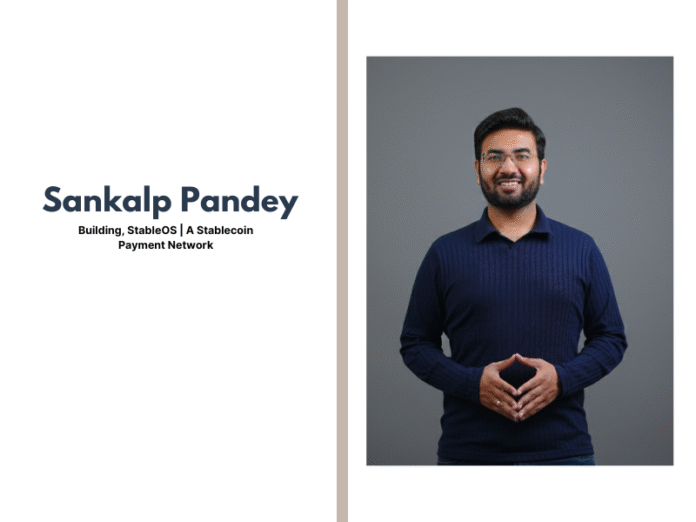

In a digital world accelerating toward decentralised money, only a handful of visionaries truly understand what the global financial system will require in the next decade. Among the architects shaping this new era is Sankalp Pandey, Founder at StableOS, whose work sits at the intersection of blockchain design, financial engineering and the future of global payments.
His journey is defined by a powerful combination of systems thinking, deep research and an unwavering belief that the next generation of money must be frictionless, sovereign and accessible to all. Sankalp’s contributions to StableOS are not just technical innovations. They represent a reimagination of how billions of people, businesses and markets will move money across borders.
Yet for Sankalp, this mission began not with technology, but with a single question that revealed the industry’s biggest blind spot.
He recalls,
“Why does the world still not have a fully functional, seamless Stablecoin payment network when stablecoins have grown more than two hundred times in under two years?”
This question became the foundation of one of the most ambitious stablecoin payment infrastructure models in the industry today.
The Curiosity That Sparked a Vision for Financial Reinvention
Sankalp’s fascination with financial systems began years before he entered the stablecoin ecosystem. He was always drawn to understanding what lies beneath the surface, from why legacy rails dominate global transactions to why promising technologies struggle to scale beyond prototypes.
While the crypto world celebrated explosive growth, Sankalp noticed something others overlooked. Stablecoins were expanding exponentially, but stablecoin payments were not.
He observed that many teams were innovating, but most were building narrow components in isolation. Very few were attempting to solve the entire stack or design a functional, sovereign payment network.
“Crypto payments are often stitched on top of card systems, and that defeats the purpose of stablecoins.”
Instead of joining the wave of fragmented innovation, Sankalp chose to rethink the foundation itself.
The Realisation That Changed Everything, Fragmentation Was the Enemy
Through global research, conversations with founders, regulators and payment operators, Sankalp discovered a pattern repeating across the industry.
Stablecoin adoption was surging, yet the ecosystem relied heavily on disjointed modules and legacy intermediaries.
He found that:
- Wallets functioned on one layer
- Gateways operated separately
- Settlement happened somewhere else entirely
- Compliance sat outside the transaction stack
- And traditional card networks still handled the actual payment execution
The result was predictable.
An infrastructure too fragmented to scale and too dependent on legacy rails to unlock true innovation.
Instead of building another plugin, API or wallet patch, Sankalp began envisioning what a sovereign full-stack stablecoin payment network could look like. Not theoretical. Not partial. But complete.
A Vision Rooted in Simplicity, Stablecoins Should Work Like Money
At the core of Sankalp’s thinking is a simple, powerful belief.
“The end user should never feel the blockchain. They should just feel fast, reliable and affordable payments.”
To him, stablecoin systems must behave like money, not like complicated technology. This philosophy became the cornerstone of StableOS’ approach to building a network that merges the predictability of traditional finance with the sovereignty of on chain settlement.
Designing a Full Stack On-Chain Payment Infrastructure and Network, Sankalp’s Most Ambitious Work
What distinguishes Sankalp’s approach is his insistence on building a monolithic, vertically integrated stablecoin payment infrastructure.
He believes a truly functional stablecoin economy requires:
- its own acceptance stack
- Its own issued cards and PoS
- its own routing layer
- its own settlement engine
- its own compliance environment
- its own liquidity and reserve architecture
All on chain. All sovereign. All interoperable.
He explains,
“If the system relies on traditional card networks or legacy rails, it will always inherit their limits. To innovate, you must own the system end to end.”
This principle shapes how he conceptualises StableOS and evaluates every layer of its architecture.
Engineering Web2 Grade Simplicity with Web3 Grade Finality
One of the most complex challenges Sankalp focuses on is merging the smooth experience of Web2 payment systems with the trust and finality of Web3 technology. While instant settlement is easy for a chain, predictable user experience is not.
Sankalp’s research identified the needs of each stakeholder:
- Users need transparency
- Merchants need predictability
- Businesses need compliance
- Regulators need visibility
- And every participant wants simplicity
This insight led to a hybrid approach.
A system that combines blockchain native trust with Web2 accessibility, creating a seamless flow between initiation, routing, settlement and compliance.
Where Stablecoins Solve Real Problems, Sankalp’s Global Lens
Sankalp often emphasises that real financial innovation must respond to real world problems. That is why he studies markets in Africa, LATAM and Southeast Asia, where:
- inflation weakens daily income
- USD access is limited
- crypto is an everyday survival tool
- banking systems face reliability issues
He says,
“People in these regions do not use stablecoins for hype. They use them because they work.”
These regions validate the need for a payment system designed from the ground up to solve real pain points.
Trust, Security and Compliance, The Foundation of Sankalp’s Thinking
For Sankalp, trust is not decorative. It is the foundation of stablecoin payments. His architecture prioritises:
- on chain finality
- auditable settlements
- automated risk rules
- secure validator level trust
- regulated fiat touchpoints
- AML aligned transaction flows
This ensures innovation never compromises safety or reliability.
About StableOS
The Full Stack Stablecoin Payment Infrastructure and Network Designed for a New Financial Era
Stablecoins need their own home to move, breathe and rest. StableOS is that home.
StableOS is a full-stack, stablecoin-focused, closed-loop payment network that owns and operates every layer of the payment experience on chain.
Its sovereign architecture integrates:
- card issuance
- merchant acquiring
- POS terminals
- payment gateways
- QR payment rails
- consumer P2P and P2M applications
- Neobank
All under one vertically aligned infrastructure designed for one mission,
to make cross-border payments actually cheap.
Today, crypto companies issue Visa or Mastercard cards that depend on open-loop systems with six to seven intermediaries per transaction. This dependence locks the ecosystem into legacy constraints, restricts DeFi functionality and limits innovation.
StableOS removes these barriers.
Its underlying payments infrastructure empowers stablecoin issuers in the underbanked regions and creates an impact on the local stablecoin issuers’ adoption, making the infrastructure programmable, allowing builders to build more consumer-focused utility-based applications, neobank infrastructure, etc.
StableOS is not an extension of legacy Rails.
It is a new foundation.
Sankalp’s Systems Mindset, Built for the Future of Financial Infrastructure
Behind Sankalp’s analytical precision lies a deeper trait: curiosity.
Curiosity drives every question he asks, every architecture he constructs and every assumption he challenges.
He believes,
“Curiosity keeps you learning and growing. Without it, you will fall behind in an industry that changes this fast.”
This mindset fuels his vision for a network that is simple enough for consumers, powerful enough for institutions and sovereign enough to scale across borders.
His View on the Future of Stablecoins
Sankalp believes stablecoins will become:
- the backbone of international payments
- the default store of value in inflation heavy regions
- the first programmable global currency
- the infrastructure layer for digital trade
- interoperable across chains without friction
But only if the payment infrastructure evolves beyond fragmentation and dependency.
“The world does not need more stablecoins. It needs a stablecoin ecosystem that actually works.”
The Next Wave of Disruption, Sankalp’s Prediction
He anticipates breakthroughs powered by:
- seamless cross border movement
- unified digital identification
- real time on chain routing
- sovereign payment layers across countries
He adds,
“The next disruption will come from seamless integration. People should move between geographies and systems as easily as switching apps.”
A Message for the Next Generation of Innovators
Sankalp’s advice is simple, grounded and deeply relevant.
“Keep yourself updated. The industry is changing fast and the leaders who stay curious and continue learning are the ones who will build the future.”
A Leader Building the Future of Global Stablecoin Payments
Today, Sankalp stands at the forefront of a financial transformation that promises to redefine how the world moves money. His work reflects precision, curiosity, long term vision and a commitment to solving real problems that affect real people.
As stablecoins continue to reshape the financial landscape, leaders like Sankalp Pandey will define the next chapter. His belief in sovereign, full stack stablecoin payment infrastructure is not just an idea. It is the blueprint for a world where digital money finally functions the way it was always meant to: simple, secure and truly borderless.