
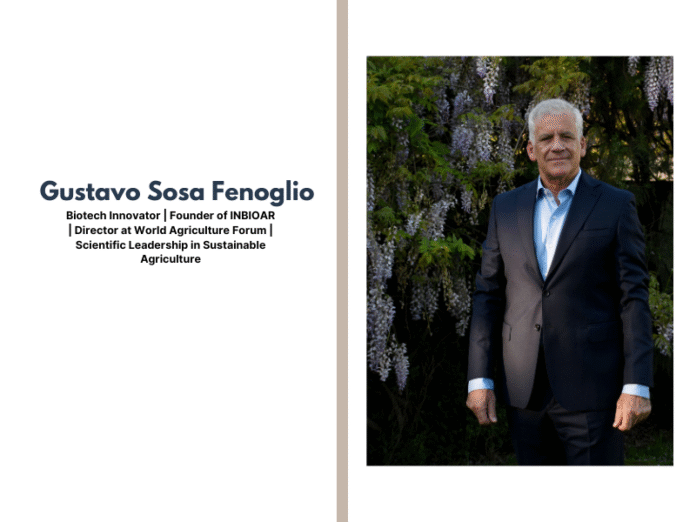

From the fertile plains of Argentina to global stages of agricultural innovation, Gustavo Sosa Fenoglio has built a career rooted in both science and purpose. As the Founder of INBIOAR and Advisor at the World Agriculture Forum, he stands at the crossroads of biotechnology, sustainability, and entrepreneurship — transforming plant research into practical tools that empower farmers worldwide.
His story is not one of sudden breakthroughs, but of persistence, collaboration, and conviction that science must serve people first.
A Lifelong Mission: Helping Farmers Grow Smarter
When asked about the origin of his journey, Gustavo smiles and begins simply: “My North has always been the farmer.”
For him, that guiding principle has never wavered. Every experiment, every patent, every field test — all circle back to a single question: Does it help the farmer make a living?
Unlike many biotech pioneers who chase technology for its own sake, Gustavo views innovation through a human lens. A discovery means little, he insists, if it cannot withstand the dust, wind, and unpredictability of the field. “It’s easy to design an impressive molecule on paper,” he says, “but the real test of innovation is whether it works on a farm in Rosario, in Iowa, or in Kenya.”
That pragmatic empathy defines the ethos of INBIOAR, the Argentine biotech company he founded to discover natural bioherbicides, biostimulants, and biological crop protection solutions.
Turning Plants Into Possibility
At the core of INBIOAR’s success lies a scientific curiosity that began decades ago with a single plant: Algarrobo Blanco (Prosopis alba). As a forestry student, Gustavo was fascinated by its resilience and its ability to inhibit the growth of surrounding plants — an early glimpse into what would later become his field of expertise: plant-derived bio-inhibitors.
Years of research led him to uncover how nature itself develops biochemical defenses. Working alongside Dr. María Lucía Travaini, one of his early Ph.D. protégés, he designed a proprietary discovery platform capable of screening thousands of plant extracts and identifying a handful with real-world potential.
Their findings were revelatory: plants growing in low-rainfall regions often evolved stronger inhibitory compounds. These extracts became the blueprint for INBIOAR’s library of bioactive molecules — candidates for the next generation of eco-friendly agrochemicals that could compete with conventional synthetics.
“Science alone doesn’t make a product,” Gustavo explains. “We needed a discovery system that connected nature’s chemistry with the economics of farming. Otherwise, innovation would remain locked in the lab.”
From the Lab to the Land
The heart of Gustavo’s approach is co-creation — working hand in hand with the very people who will use his technology. Before launching any product, he spends time listening to farmers’ pain points.
“The first person you must listen to is the farmer,” he says. “If they don’t believe in your solution, no regulation, investor, or scientist can make it succeed.”
It was precisely those farmer conversations that steered INBIOAR toward organic and sustainable crop protection. Argentine producers wanted to transition toward cleaner practices, not for idealism but for profitability. “When organic farming became a better business, it also became a shared goal,” Gustavo notes.
That insight drove INBIOAR to focus on natural compounds that not only reduce chemical residues but also deliver equal or superior yield performance — proving that sustainability and profitability are not opposites but allies.
Ethics, Biodiversity, and the Spirit of Collaboration
Gustavo’s respect for nature is not only scientific but ethical. Under his leadership, INBIOAR became one of the first Latin-American biotech companies to integrate the principles of the Nagoya Protocol into every stage of its research.
“We never collect a plant without permission,” he explains. “Biodiversity belongs to the State — and to humanity. Following ethical rules protects both.”
Many of the plants INBIOAR studies are humble roadside weeds, species that thrive in Argentina’s varied climate. Yet even here, strict permits are obtained — a gesture of respect that has earned the company credibility in global partnerships.
“Ethical biodiversity exploration is not just about legality,” Gustavo says. “It’s about trust — with governments, with communities, and with the environment itself.”
That spirit of trust has become one of INBIOAR’s most valuable assets, enabling collaborations with the USDA, international research centers, and universities around the world.
The Art of Making Science Understandable
For all his scientific rigor, Gustavo’s greatest leadership skill may lie in communication. Bridging academia and business, he learned early that brilliant ideas mean little if investors or farmers can’t grasp them.
“One of our biggest challenges,” he recalls, “was explaining very complex science in language everyone could understand. We had to make science relatable — a story that connects the lab bench to the dinner table.”
That philosophy helped INBIOAR attract both funding and partnerships. It also positioned the company as a thought leader in applied plant biotechnology — translating high-level molecular research into tangible benefits for sustainable agriculture.
Science, Curiosity, and the Courage to Evolve
Behind Gustavo’s calm demeanor lies an insatiable curiosity. After earning a Ph.D. in plant biochemistry, he pursued postdoctoral research at The Ohio State University, studying gene expression and the molecular mechanisms of stress tolerance. Yet even as he achieved academic success, he sensed a new calling.
“I realized that publishing papers was not enough,” he says. “I wanted to see science changing lives.”
That realization propelled him into entrepreneurship. Through venture capital and angel investment, he transformed his research into enterprises that connected discovery with global markets. “I learned that innovation isn’t about working alone,” he reflects. “It’s about building teams where science, business, and vision meet.”
Collaboration as a Core Value
Gustavo’s philosophy on partnership is refreshingly honest. “Scientists often believe they can do everything themselves,” he says. “In industry, that’s impossible.”
He believes collaboration must be mutually challenging — partners should bring perspectives that push each other forward. “If my business partner tells me something uncomfortable, it means we’re growing,” he laughs.
This openness to collaboration has shaped INBIOAR’s identity. From joint research with the USDA on visnagin purification to his advisory role at the World Agriculture Forum, Gustavo has learned to navigate the delicate balance between scientific discovery and global market expectations.
“Diversity of perspective,” he emphasizes, “is the oxygen of innovation.”
Redefining Sustainable Agriculture
Ask Gustavo about the future of farming, and his answer blends optimism with realism. “Biotechnology will not replace traditional agriculture,” he explains. “It will refine it — make it cleaner, safer, and more efficient.”
He envisions a decade where natural bioherbicides and biostimulants stand alongside conventional products as mainstream choices, driven by farmers’ demand for efficacy and profitability.
“Farmers won’t choose sustainability if it means losing money,” he admits. “That’s why our mission is to make green solutions perform just as well — or better — than synthetic ones.”
To achieve that, INBIOAR conducts extensive field testing in collaboration with local producers. “The learning curve is slow,” Gustavo acknowledges, “but when farmers see results with their own eyes, adoption follows.”
Beyond Agriculture: The Frontier of Natural Compounds
Although agriculture remains INBIOAR’s primary focus, Gustavo’s curiosity continues to expand into other fields — including biomedicine. His team has screened more than 100 plant extracts for anti-cancer activity, uncovering promising compounds from native Gaillardia species that showed tumor-reducing potential in animal models.
“It’s a reminder,” he says, “that nature still holds countless secrets. The challenge is not finding molecules — it’s finding time to explore them all.”
Even if those projects remain dormant for now, Gustavo’s passion for interdisciplinary discovery underscores his belief that biotechnology is not an industry — it’s a philosophy of progress.
Mentoring the Next Generation of Innovators
Walk into INBIOAR’s laboratory in Rosario, and you’ll sense a unique atmosphere — one of freedom, trust, and shared purpose. There are no rigid hierarchies, no strict hours. What matters is responsibility and results.
“My lab is not for everyone,” Gustavo admits. “The freedom is extreme, but so are the expectations.”
He believes that innovation thrives when young scientists are empowered to explore their ideas independently. “They see me as a colleague, not a boss,” he says. “That’s how creativity grows.”
His mentorship philosophy is simple yet profound: Give people tools and trust them to build something greater than you imagined.
Argentina’s Role in the Global Biotech Renaissance
For Gustavo, Argentina is more than home — it is fertile ground for the future of sustainable agriculture. “Latin America is the future,” he declares. “We have land, biodiversity, and a culture of resilience.”
He envisions Argentina leading a new era of bio-innovation, fueled by the continent’s diverse ecosystems and scientific talent. “We don’t need to copy Silicon Valley,” he adds. “We can build our own model — one rooted in biology, ethics, and collaboration.”
Already, INBIOAR’s research partnerships extend from Kenya to the United States, proving that Argentine innovation can compete — and lead — on a global stage.
Leadership Redefined: Empowerment Over Authority
When Gustavo speaks about leadership, his tone softens. “A true leader,” he says, “is more like an assistant — someone who helps others grow.”
He rejects the old model of hierarchy and ego. “Leadership is not about being the best scientist or the loudest voice. It’s about vision — seeing problems clearly and empowering your team to solve them.”
That mindset has shaped INBIOAR’s internal culture, where collaboration replaces competition and success is measured by collective progress.
A Legacy Rooted in Freedom and Integrity
Looking back, Gustavo defines his legacy not in patents or profits but in values. “If I am a mirror,” he says, “then what people see depends on how they choose to look.”
Inside the lab, discussions are calm, voices never raised. Every experiment carries a quiet discipline: If the best work cannot be done, it’s better not to do it at all.
These principles — excellence, respect, and authenticity — form the DNA of INBIOAR. They are also the legacy he hopes to pass on to every scientist, farmer, and entrepreneur he meets.
A Philosophy of Trust
Asked to summarize his leadership philosophy, Gustavo’s answer could serve as a manifesto for ethical innovation:
“Think of others as colleagues. Think of others as yourself when you were starting out. Give people the tools they need to grow, and trust them.”
He pauses before adding, “There are many ways to reach the right outcome — not just one. Science, like life, thrives on diversity.”
The Seeds of Tomorrow
In a world searching for sustainable solutions to feed a growing population, Gustavo Sosa Fenoglio stands as both innovator and philosopher — a scientist who never forgot the soil beneath his feet.
From his early experiments with native Argentine plants to his global advocacy for responsible biotechnology, he has shown that progress need not come at the expense of ethics or empathy.
His message to the next generation of leaders is timeless: “Innovation is not about changing nature. It’s about learning from it.”
And with that, he continues to cultivate the fields of science — not only to feed the world but to remind it of the power of curiosity, collaboration, and trust.