
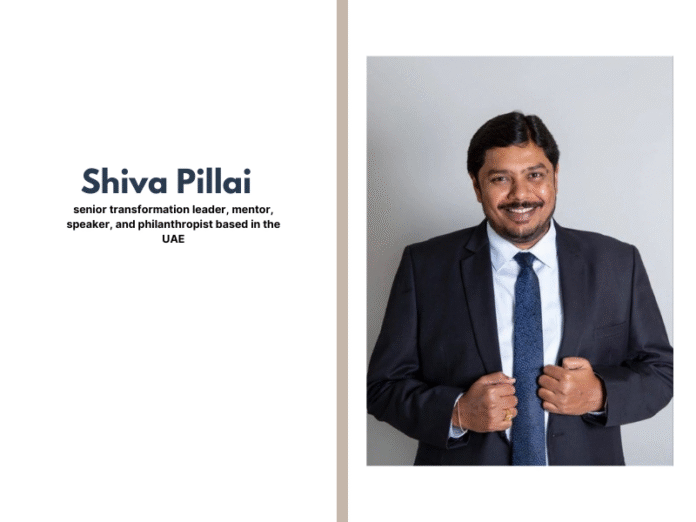

In an era where digital transformation defines competitiveness, Shiva Pillai has spent more than two decades shaping how enterprises evolve—technologically, operationally, and ethically.
As a senior transformation leader, mentor, speaker, and philanthropist based in the UAE, he embodies a rare blend of technical mastery, cultural intelligence, and human-cantered leadership. His career, spanning industries from Service, manufacturing to defence, reflects one consistent principle: transformation succeeds when technology and people move together.
The Journey of Reinvention
Shiva’s career began in ERP (SAP) implementations—an entry point that revealed both the power and the limitations of technology. “I learned early that success depends as much on people and culture as on systems,” he recalls.
From that realization emerged his passion for transformation leadership—guiding organizations not just to adopt digital tools, but to reinvent how they create value.
Across 20 years, he has delivered multimillion-dollar programs across Asia, the Middle East, and Europe, for sectors such as oil & gas, services, aviation, and manufacturing. Whether leading $5 million digitalization projects or $50 million global integrations, his approach has remained rooted in vision, discipline, and empathy.
Redefining Digital Transformation
For Shiva, digital transformation is not a synonym for technology deployment—it is organizational reinvention. Early in his journey, transformation meant ERP rollouts and automation for efficiency.
Today, he defines it as “reimagining business models, empowering people, and embedding a culture of agility.”
He illustrates this evolution through three phases:
- Tech-centric modernization — upgrading systems for stability and speed.
- Integrated optimization — connecting functions like finance, procurement, and logistics to unlock visibility.
- Holistic reinvention — creating data-driven, customer-centric, and adaptive enterprises where technology amplifies culture, not replaces it.
The Architecture of Successful Transformation
Behind every large-scale program lies a disciplined architecture. Shiva attributes sustainable success to six pillars:
- Clarity – executive alignment and shared purpose.
- Governance – a strong PMO, risk controls, and transparent KPIs.
- Value focus – connecting every activity to measurable ROI.
- Balanced delivery – combining agile velocity with quality control.
- Data discipline – real-time analytics for evidence-based decisions.
- People engagement – change management, training, and accountability.
His mantra: “Speed without direction creates rework. Slow down to strategize, so you can accelerate with purpose.”
Leading Through Strategy, Not Speed
In the high-pressure world of transformation, Shiva’s philosophy—“slowing down to strategize accelerates transformation”—has become his signature.
He believes that investing time in stakeholder alignment, visioning, and culture building ensures smoother execution later. “Transformation fatigue comes from haste,” he says. “Clarity at the start prevents chaos at the end.”
This disciplined patience has earned him recognition as one of the GCC- Top 10 Tech Leaders to Watch 2025 and Digital Transformation Leader – UAE (2024 & 2025), honors he describes as “motivation to keep serving with responsibility.”
The SAP Landscape: From Systems to Strategy
As a veteran of SAP transformations, Shiva has witnessed the platform’s evolution from back-office tool to strategic enabler.
He highlights trends reshaping the landscape:
- Cloud-first adoption and modular architectures.
- AI-driven intelligence through SAP Joule and embedded analytics.
- Hyper-automation integrating RPA, IoT, and low-code platforms.
- Sustainability reporting and ESG integration.
“ERP is no longer just about transactions—it’s about intelligence,” he explains. “SAP is becoming the digital nervous system of the enterprise.”
Data: The Hidden Hero of Transformation
Among Shiva’s many projects, one stands out—a global S/4HANA migration for a manufacturing giant where data governance determined success.
By cleansing millions of records, harmonizing legacy systems, and embedding API-driven integration, the team achieved 99.5 percent clean migration with zero downtime.
“The real success,” he emphasizes, “was not in moving data but in earning trust. When the business believes the data, transformation becomes irreversible.”
The result: end-to-end supply-chain visibility, 40 percent faster reconciliation, and days saved on monthly close cycles.
Stakeholder Alignment in a Global Mosaic
Leading teams across 4 countries demands more than communication—it requires cultural intelligence.
Shiva structures stakeholder management around three principles:
- Clarity of purpose through transparent OKRs and RACI matrices.
- Cultural adaptability, respecting local decision-making norms while maintaining global coherence.
- Structured governance, with steering committees, dashboards, and feedback loops that balance information and agility.
“Clarity builds trust, and trust builds momentum,” he notes. “When everyone sees progress in their own language, alignment follows naturally.”
Innovation Within Regulation
Working with giants such as SOLVAY PHARMA, LUBEREF, TASNEE Petro Chemicals, SAUDIA, ADNOC and EDGE Group, Shiva has mastered the art of innovating within compliance.
“In regulated sectors, regulation isn’t a barrier—it’s a design constraint that sparks smarter solutions,” he says.
By embedding innovation inside governance frameworks and adopting a dual-speed operating model, his teams deliver agility without compromising resilience.
Mentoring the Next Generation
Shiva currently mentors multiple leaders across multiple organizations, focusing on building future-ready leadership.
He defines tomorrow’s leaders as adaptable, emotionally intelligent, digitally fluent, and purpose-driven.
“Titles fade,” he says, “but curiosity and empathy never go out of style.”
Aspiring future leaders should prioritize the development of mindset and psychology over technological skills. While technology continues to evolve at breakneck speed, the public domain is saturated with tutorials, technology platforms and open-source digital solutions. What’s scarce and far more valuable is the cultivation of attitude, psychological resilience and ethical clarity.
He teaches autonomy through accountability—setting clear OKRs, granting freedom in execution, and using transparent metrics to maintain trust.
“Leadership today is less about control and more about orchestration,” he explains. “Great leaders conduct, they don’t command.”
Speaker and Thought Leader
As a public speaker across SAP and project-management forums, Shiva brings thought leadership to topics that resonate with modern executives:
AI and automation in enterprise systems, cloud migration challenges, workforce readiness, project governance, and ESG integration.
His talks bridge the gap between strategy and empathy, urging leaders to see transformation as a journey of people first, platforms second.
Awards as Affirmations, Not Endpoints
For Shiva, professional recognition is not an endpoint but an encouragement. “Awards remind us to keep raising the bar,” he reflects.
They affirm his principle that leadership is service—an opportunity to use technology to deliver measurable value and human impact simultaneously.
Giving Is Living: The Sathya Unar Trust
Beyond boardrooms, Shiva’s heart beats for social transformation. He founded the Sathya Unar Charitable Trust in Tamil Nadu, India. which now supports more than 200 underprivileged children through education, nutrition, and sustainability programs.
What began as small volunteer efforts evolved into structured initiatives:
- Thulir – scholarships for higher education.
- Gurukulam – skill-building and employability training.
- Amudhabojanam – nutrition and food support.
“I saw education as the surest path out of poverty,” he explains. “Every rupee invested in learning returns a lifetime of dignity.”The 2030 Vision: Educating 1,000 Students
By 2030, the Trust aims to educate 1,000 students. The roadmap includes:
- Digital application portal for transparent, scalable scholarship management.
- CSR partnerships with corporates to secure recurring funding.
- Mentorship networks linking alumni and volunteers.
- Retention support via nutrition and counselling to reduce dropouts.
Already, several beneficiaries have returned as donors —a full circle of empowerment Shiva calls “the most rewarding KPI of all.”
The Future of Digital Transformation
Looking ahead, Shiva envisions enterprise ecosystems driven by AI-powered intelligence, hyper-automation, and human–machine collaboration.
ERP ( SAP, Oracle, Salesforce etc..) systems will evolve into self-learning networks, while data becomes the ethical fuel of competitive advantage.
“The next decade,” he predicts, “won’t be about adoption but orchestration—balancing innovation with ethics, speed with sustainability, and automation with human judgment.”
He calls it the rise of “living, learning enterprises”—organizations that continuously sense, adapt, and improve.
Balancing Profit and Purpose
Asked what advice he gives to emerging leaders, Shiva’s answer is simple yet profound:
“Treat profit and purpose as allies, not opposites. Build organizations that win in the market and matter to society.”
He believes that integrity, empathy, and long-term vision will define the next generation of leadership. “The leaders who last,” he says, “are those who serve.”
A Legacy of Impact
From leading billion-dirham transformations to educating children from remote villages, Shiva Pillai stands for a modern leadership ideal—one that unites corporate excellence with human purpose.
As technology redefines how the world works, he continues to redefine why it works—proving that when innovation serves humanity, transformation becomes timeless.