
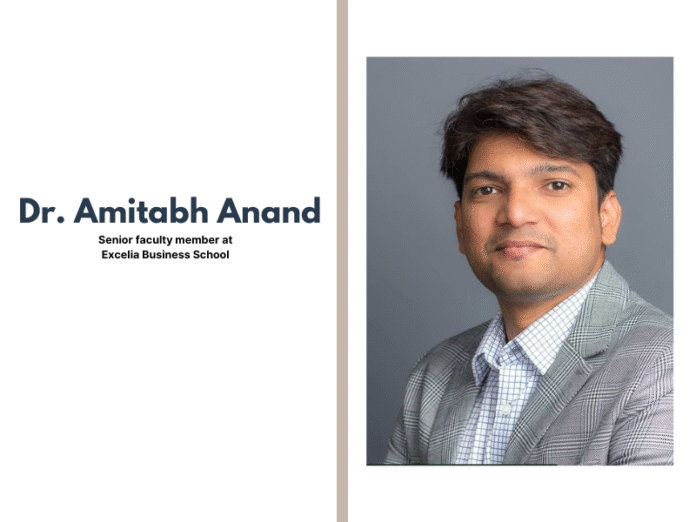

In the evolving world of management education, few scholars embody the seamless integration of research, ethics, and global leadership like Dr. Amitabh Anand. An award-winning academic, researcher, and mentor, Dr. Anand’s work spans ethics, entrepreneurship, sustainability, and organizational behavior — disciplines he weaves together with a singular purpose: to make academia more humane, connected, and impactful.
Currently serving as a senior faculty member at Excelia Business School in France and leading the HOPE Research Academy (Humane Organizations and Purposeful Entrepreneurship), Dr. Anand represents a new generation of global educators who view knowledge not as static theory, but as a force for social transformation. His academic philosophy can be captured in one sentence — “Knowledge must not only enlighten the mind but also elevate the spirit.”
“My journey in academia has always been about curiosity and contribution,” he reflects. “I was drawn to understand how organizations function and how purposeful entrepreneurship can create value that goes beyond profit.”
The Making of a Purpose-Driven Scholar
Dr. Anand’s career began not in academia but in engineering — an early chapter that shaped his analytical rigor and appreciation for systems thinking. Working in environmental engineering and development in India, he gained firsthand insight into the complex interplay between human ambition, technology, and sustainability. Yet, as he delved deeper, he realized something was missing: the human dimension of how organizations truly work.
This realization led him to pursue management studies in Sweden and France, where he developed a passion for entrepreneurship and organizational transformation. His MBA experience became a turning point, inspiring him to bridge engineering precision with management purpose.
“Organizations are not machines,” he explains. “They are living systems driven by human values, decisions, and aspirations. Understanding that has shaped everything I do — as a researcher, teacher, and leader.”
Global Recognition and a Philosophy of Impact
In 2018, Dr. Anand was named among the Top 50 World’s Best Undergraduate Business Professors by Poets & Quants, an honor that placed him among the most respected educators globally. Chosen from over 400 nominations worldwide, the recognition was not only a career highlight but also a validation of his philosophy that teaching and research are inseparable.
“That recognition reminded me that excellence in teaching and research must go hand in hand,” he says. “It reinforced my belief that educators should constantly innovate — connect theories to practice, and help students become not only employable but ethically responsible global citizens.”
For Dr. Anand, academic recognition is not an endpoint but a responsibility — a call to continually redefine what effective teaching looks like in an age of disruption and digitalization.
Integrating Ethics, Sustainability, and Entrepreneurship
Few scholars manage to bridge as many disciplines as seamlessly as Dr. Anand. His research integrates ethics, entrepreneurship, sustainability, and organizational behavior into a unified narrative about how organizations can thrive with integrity.
“Ethics is the foundation of everything we do,” he emphasizes. “Without it, entrepreneurship or innovation lacks authenticity.”
His studies explore questions such as: How can startups remain purpose-driven in volatile economies? What makes sustainable practices stick? How can ethical leadership shape organizational culture? Through qualitative research and cross-cultural studies, Dr. Anand brings these themes together to reveal how moral purpose, human behavior, and entrepreneurship intersect.
“My goal is to understand how organizations and individuals can create value responsibly,” he says. “Because when purpose and performance align, real transformation happens.”
Excelia Business School and the HOPE Research Academy
At Excelia Business School, Dr. Anand combines academic leadership with innovation in teaching. Since joining in 2021, he has designed and delivered international programs that integrate ethics, sustainability, and digital transformation. One of his initiatives, the “Doing Business in Europe” course, won a Pedagogical Innovation Award in 2020 for its experiential approach to teaching cross-border business dynamics.
Beyond teaching, his work extends to leading the HOPE Research Academy (Humane Organizations and Purposeful Entrepreneurship), a pioneering platform that fosters research and education centered on ethical, sustainable, and people-focused business practices.
“Through HOPE, we’re reimagining entrepreneurship,” he says. “We’re guiding students and researchers to see business not just as a profit engine, but as a force for positive societal change.”
The academy’s projects emphasize entrepreneurship with empathy — a philosophy Dr. Anand believes will define the future of business.
The Art and Science of High-Impact Research
Having received numerous awards for his research and reviewing contributions, Dr. Anand defines high-impact research as work that is innovative, rigorous, and relevant.
“Great research starts with an idea that challenges assumptions and ends with insights that change practices,” he says. “It must be methodologically sound, contextually meaningful, and globally relevant.”
He emphasizes that management research should not be confined to Western paradigms. Emerging economies, he argues, offer rich and underexplored contexts that can reshape how we understand entrepreneurship, ethics, and organizational behavior. His work encourages a more inclusive global dialogue — one that gives voice to diverse geographies and cultural perspectives.
Bridging Continents through Collaboration
Dr. Anand’s academic career is inherently global. Having taught or collaborated with institutions such as Corvinus University of Budapest in Hungary as a research fellow, Pargaue University of Business and Economics, Czech Republic as a Ph.D supervisor, and Aalborg University, Denmark as an Affiliate, he views international exposure not just as professional enrichment but as a source of humility and inspiration.
“Every institution, every country, and every classroom teaches you something new,” he says. “Global collaboration expands your worldview, sharpens your empathy, and helps you see connections between seemingly unrelated ideas.”
However, he acknowledges that cross-border collaboration also brings challenges — from differing academic expectations to time zone barriers — but insists the rewards far outweigh the difficulties. “Research thrives when boundaries dissolve,” he notes.
Purpose-Driven Business and the Future of Work
As global economies shift toward sustainability, Dr. Anand’s vision of purpose-driven business feels increasingly urgent. He defines it as an enterprise that creates meaningful impact on society, the environment, and human well-being — not merely financial success.
“Businesses that prioritize purpose create cultures of resilience, integrity, and trust,” he explains. “Purpose is no longer a luxury; it’s the foundation of relevance in today’s volatile world.”
His research through the HOPE Academy explores how ethical entrepreneurship can drive inclusive growth, reduce inequality, and respond to global challenges like climate change and digital disruption.
Ethics, Well-Being, and Entrepreneurship in Emerging Economies
Dr. Anand’s work on quiet quitting and disengagement in India’s corporate sector has gained international attention. The study, involving 264 managers, revealed how post-pandemic workplace practices have affected employee morale, recognition, and well-being.
“Ethics and well-being aren’t optional — they’re essential for resilience,” he asserts. “In emerging markets, trust, fairness, and psychological safety determine whether ventures thrive or collapse.”
This research underscores his long-standing belief that organizations must integrate ethical principles into their very DNA. For Dr. Anand, well-being isn’t just about employee satisfaction; it’s a strategic imperative that fuels productivity, retention, and innovation.
Mentorship and the Future of Research
As a mentor to early-career scholars across Europe and Asia, Dr. Anand promotes clarity, rigor, and resilience. His approach balances empathy with structure, helping emerging researchers build confidence and credibility.
“I tell my students that rejection isn’t failure — it’s feedback,” he smiles. “The goal is not just to publish, but to grow as thinkers, to ask better questions, and to contribute meaningfully.”
He encourages his mentees to engage with systematic reviews and bibliometric research, a field he passionately supports. Through bibliometric analysis, scholars can track emerging trends, map collaborations, and enhance the visibility of their research. However, he cautions against an overreliance on metrics.
“Numbers are tools, not trophies,” he says. “They should guide our direction, not define our worth.”
Digital Globalization and Education’s New Frontier
As an educator deeply engaged with technology, Dr. Anand recognizes that digital globalization is transforming management education. Virtual classrooms, AI-powered tools, and international collaborations are reshaping how students learn and how institutions deliver impact.
“Digital globalization democratizes education,” he observes. “It allows us to reach students across continents while personalizing their learning experience.”
However, he warns that with this opportunity comes responsibility — particularly around ethics, data use, and inclusivity. “Our challenge is to ensure that digital transformation remains human-centered,” he says. “Technology should connect, not divide.”
A Vision for the Future of Entrepreneurship Education
Looking ahead, Dr. Anand envisions entrepreneurship education evolving into an experiential, interdisciplinary, and purpose-driven model. In the age of AI, he believes future entrepreneurs will need not just business acumen but also ethical intelligence — the ability to innovate responsibly.
“The future belongs to entrepreneurs who can combine data with empathy,” he says. “Those who understand that innovation must serve society, not just shareholders.”
He foresees AI-driven learning systems, global simulation platforms, and circular economy challenges becoming central to management education. Yet his message remains timeless: technology must always serve humanity.
Balancing Leadership, Research, and Mentorship
Managing teaching, research, and administrative roles across multiple institutions is no small feat. Dr. Anand’s secret lies in discipline, delegation, and purpose alignment.
“Every task must align with your larger purpose,” he explains. “When you know why you’re doing something, it becomes easier to manage the how.”
He plans his week meticulously, dedicating focused time for writing, mentoring, and reflection. For him, balance is not about doing everything at once but about doing the right things with intent.
Knowledge Sharing with Pleasure: The SKARP Philosophy
Perhaps the most defining aspect of Dr. Anand’s professional identity is his initiative, SKARP — Sharing Knowledge and Research with Pleasure. The platform embodies his philosophy of openness, mentorship, and intellectual generosity.
“Knowledge grows when it’s shared with joy,” he says. “Collaboration is not competition; it’s community.”
Through SKARP, he encourages scholars to embrace curiosity, collaboration, and compassion — the three “C’s” he believes academia needs most.
The Joy of Lifelong Learning
Despite his many achievements, Dr. Anand remains grounded and curious — qualities that continue to fuel his innovation in both classroom and research.
“I still see myself as a student,” he says. “Every lecture, every project, every collaboration is a chance to learn something new.”
This learner’s mindset keeps his teaching dynamic and his research relevant. Whether he’s exploring AI ethics, sustainable leadership, or organizational behavior, his curiosity ensures his work remains future-facing and deeply human.
A Legacy of Purpose and Possibility
When asked what drives him after decades of academic excellence, Dr. Anand smiles: “Purpose,” he says simply. “Purpose keeps me inspired, and people keep me humble.”
He envisions a future where universities become ecosystems of empathy and innovation, where teaching and research merge seamlessly, and where knowledge creation serves humanity as much as it advances science.
“Academia must be both a mirror and a lamp,” he concludes. “It should reflect the world as it is, and illuminate the world as it could be.”