
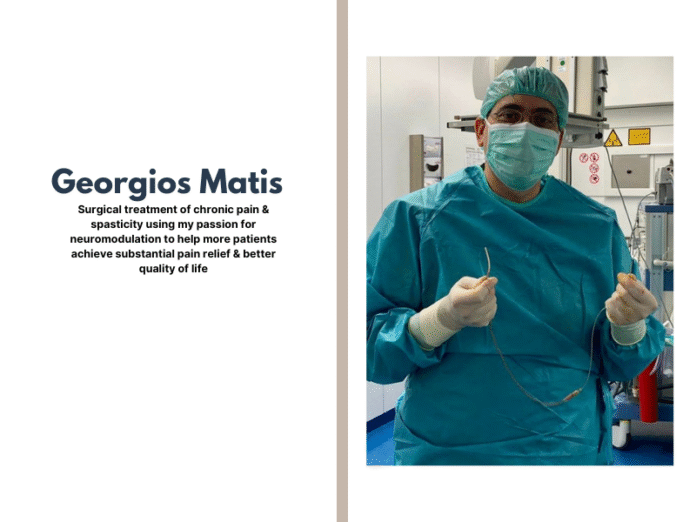

In a city where philosophy was born and medicine first intertwined with ethics, Athens now witnesses a new chapter of healing led by Dr. Georgios Matis. As Head of the Chronic Pain & Spasticity – Neuromodulation Unit at Hygeia Hospital, his work stands at the intersection of neuroscience, compassion, and innovation. For Dr. Matis, neuromodulation is not merely a surgical specialty—it is a philosophy of life, one that seeks to harmonize body and soul through the subtle language of electrical impulses and human empathy.
A Journey Inspired by the Dialogue Between Science and Soul
Every calling has an origin story. For Dr. Matis, the spark ignited not in a laboratory but in a question—what truly is pain? His fascination with the convergence of biology and electricity soon evolved into a lifelong devotion to neuromodulation, a field that transforms suffering into recovery through technology that listens to the nervous system itself.
Early in his career, while working with patients who had exhausted every conventional therapy, he discovered that behind chronic pain lay something profoundly human—a silent struggle for dignity, hope, and belonging. “Pain,” he reflects, “is not only a physiological phenomenon. It is existential, emotional, and social. To heal pain is to restore harmony.”
That conviction carried him from Germany to Switzerland and eventually back to his homeland, Greece, armed with years of surgical expertise and a philosophy rooted in Plato’s holistic vision of medicine—where healing is both science and art, reason and compassion entwined.
The Evolution of a Field—and a Philosophy
During his tenure at Uniklinik Köln, where he led the Pain and Spasticity Section for over seven years, Dr. Matis witnessed transformative revolutions that reshaped the very core of neuromodulation. The introduction of closed-loop spinal cord stimulation, for instance, marked a new era where devices could think—reading electrical signals from the spinal cord and responding in real time to fluctuations in pain.
“It was the moment when technology stopped being passive,” he explains. “It began to participate in the healing process.”
Other breakthroughs soon followed: waveform diversity—including BurstDR, DTM, and FAST—allowed physicians to tailor treatment to each individual’s neurological “language,” while multifidus stimulation redefined mobility for patients trapped in cycles of immobility.
Each innovation brought new life to patients once confined by despair, proving that neuromodulation is not merely the manipulation of nerves, but the reawakening of possibility.
The Art of Listening: From Diagnosis to Transformation
In his clinical practice, Dr. Matis begins not with machines, but with silence—with the patient’s story. He listens, he says, “as a philosopher listens to a student—without presumption.”
The process of evaluation blends empirical precision with human intuition. Every intervention—be it spinal cord or peripheral nerve stimulation, multifidus modulation, or intrathecal therapy with ziconotide—is chosen through careful discernment.
This is the Aristotelian balance of phronesis: practical wisdom guided by ethics, experience, and empathy.
Yet, success for Dr. Matis is never measured in numbers or graphs. It is measured in moments—a patient walking freely after years of immobility, a mother holding her child again without pain. “The truest data point,” he smiles, “is the return of joy.”
Innovation Anchored in Humanity
What distinguishes Dr. Matis’s leadership is not only his mastery of technology but his refusal to let it overshadow humanity. As Editorial Board Member of Neuromodulation: Technology at the Neural Interface and Co-Chair of the Medical & Public Education Committee of the International Neuromodulation Society, he stands at the forefront of global innovation. Yet, he insists that every advancement must serve a moral purpose.
“Science without philosophy risks arrogance,” he says. “Innovation must always remain anchored to compassion.”
His international work exposes him to constant evolution—AI-assisted programming, remote reconfiguration of implants, and the integration of predictive analytics into pain medicine. But for all these marvels, he remains grounded in a Greek ideal that dates back millennia: techne must always serve ethos—technology must serve virtue.
Leadership as Stewardship
For Dr. Matis, leadership is not about authority but about stewardship—the nurturing of minds, talents, and shared purpose. “In surgery as in philosophy, no one arrives alone,” he says. “We advance only through dialogue.”
His approach to teamwork at Hygeia Hospital reflects this ethos. Each voice—whether surgeon, physiotherapist, or nurse—contributes to a collective harmony where the patient is the central melody. The same principle guides his mentorship of young doctors and researchers, whom he encourages to cultivate curiosity before certainty.
He often quotes Seneca: ‘While we teach, we learn.’ That humility, he believes, is the essence of both great science and great character.
When Technology Meets the Human Heart
One of the most defining stories of Dr. Matis’s career involves a woman with persistent spinal pain syndrome following multiple back surgeries. Years of suffering had left her despondent, confined, and detached from her passions. After the introduction of a closed-loop spinal cord stimulator, her pain reduced from unbearable to almost negligible.
Four years later, she was walking ten kilometres daily, tending her garden, and—most poignantly—laughing again.
“What she regained was not only motion,” he reflects, “but meaning.”
Such stories remind him that every electrode implanted carries within it a story of rebirth. The physician, in this view, is both scientist and storyteller—translating human suffering into a language that technology can understand, and then translating healing back into the language of life.
The Greek Perspective: Medicine as Dialogue Between Mind and Cosmos
Perhaps what makes Dr. Matis’s approach uniquely resonant for Greek readers is its philosophical texture. His reflections are steeped in the spirit of Hippocrates, Aristotle, and Heraclitus, whose teachings remain the invisible scaffolding of his practice.
When he speaks of Heraclitus’s notion that ‘everything flows,’ he evokes the evolution of medical science itself—fluid, dynamic, ever adapting. When he references Epicurus, it is not to romanticize pleasure, but to remind us that the absence of suffering is itself the highest good.
In this way, his work becomes a bridge between ancient Greek wisdom and modern neurosurgical innovation—a conversation across centuries about what it means to live, to suffer, and to heal.
A Global Citizen of Medicine
Having trained and collaborated across Germany, Switzerland, and the United States, Dr. Matis brings a truly global perspective to his Athens-based practice.
He credits Germany with teaching him rigour, Switzerland with precision, and America with dynamism. Yet he believes that true progress emerges when these influences merge.
“Each country offered me a different instrument,” he says. “But Greece—Greece gave me the melody.”
That melody now resonates in his leadership at Hygeia Hospital, where he fosters cross-border collaborations and participates actively in international societies such as the INS and the Canadian Neuromodulation Society. Through these roles, he advocates for a global exchange of knowledge—ensuring that advances in neuromodulation transcend geography, language, and privilege.
Artificial Intelligence and the Future of Healing
Asked about the next frontier, Dr. Matis points to explainable artificial intelligence (AI). Unlike opaque algorithms, explainable AI allows doctors and patients to understand why a machine recommends a certain therapy.
“It is not enough for AI to be intelligent,” he insists. “It must be ethical, transparent, and accountable.”
He envisions a near future in which AI-guided neuromodulation systems predict the optimal waveform for each patient, automatically adjust stimulation parameters, and even anticipate the need for recalibration before discomfort arises. This, he says, is the dawn of proactive medicine—healing that anticipates rather than reacts.
But, true to his philosophical roots, he reminds us: “Machines may process data, but only humans can offer empathy. The surgeon’s hand and the patient’s trust must always remain at the centre.”
The Humanistic Legacy of a Modern Physician
Beyond operating theatres and conferences, Dr. Matis is also a writer and thinker. His works—Intrathecal Therapy and Ziconotide, From Surgeons to Storytellers, and Pain and Pulses—explore the meeting point of science, ethics, and storytelling. Each text invites readers to reconsider medicine as a deeply human act—an art of interpreting suffering rather than erasing it.
“I do not want to be remembered only for procedures,” he reflects. “I want to be remembered for helping people find their laughter again.”
That sentiment echoes through his many mentorship programmes, editorial contributions, and global lectures. For him, education is not an obligation but an offering—a way of ensuring that the wisdom of one generation becomes the foundation for the next.
Education as the Pulse of Progress
As Co-Chair of the INS Education Committee, Dr. Matis advocates for a culture of continuous learning. In an interconnected world, he envisions neuromodulation as a cosmopolis—a universal city of knowledge where ideas flow freely between Athens, Toronto, and Tokyo.
Digital platforms, he believes, democratize education, allowing young surgeons anywhere to engage with global experts through webinars and interactive discussions.
“Knowledge,” he says, “is the one resource that grows by sharing.”
For students entering the field of neurosurgery or pain medicine, his advice is elegantly simple: Cultivate curiosity, endure adversity, and never let science outpace compassion. Medicine, he reminds them, is not merely a career but a calling that requires both precision and poetry.
Toward a Future of Dignity and Hope
Looking ahead, Dr. Matis speaks with measured optimism. The convergence of AI, closed-loop systems, and remote programming is transforming neuromodulation into a discipline of predictive intelligence. Meanwhile, intrathecal therapies are achieving greater specificity, offering relief with minimal invasiveness.
These innovations, he says, will redefine healthcare accessibility—bringing advanced pain solutions to every corner of the world.
Yet, when asked about his ultimate vision, he turns once again to the human spirit. “Technology evolves,” he says softly, “but the purpose of medicine does not—to restore dignity, to return people to life.”
In this, Dr. Georgios Matis stands not just as a surgeon of the nervous system, but as a philosopher of healing, reviving the ancient Greek dialogue between science and soul in the language of the twenty-first century.
Epilogue: The Music of Medicine
There is a line from Leonard Bernstein that Dr. Matis often quotes: “To achieve great things, two things are needed: a plan and not quite enough time.”
It captures the rhythm of modern medicine—a balance between urgency and aspiration. But in Dr. Matis’s hands, that rhythm becomes something more—a symphony of technology, empathy, and timeless wisdom.
From the marble corridors of ancient philosophy to the sterile precision of the modern operating room, his journey reminds us that the heart of healing has never changed. It still beats to the same eternal pulse—the human desire to live without pain, to find joy again, and to laugh freely beneath the Greek sun.