
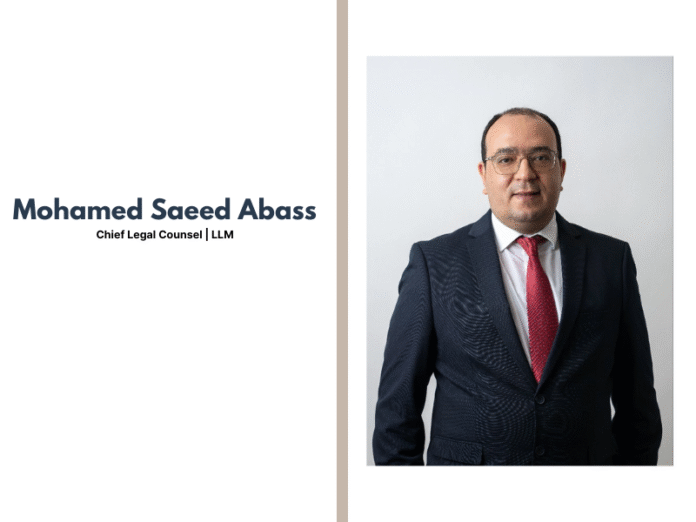

In today’s fast-evolving corporate landscape, where innovation and regulation often intersect, Mohamed Saeed Abass, Chief Legal Officer at Rayadh Facility Management, stands out as a strategic leader redefining the role of the modern legal function. With over 19 years of experience spanning banking, healthcare, finance, construction, and IT, he has consistently proven that law, when applied with insight and integrity, is not a barrier to growth but a foundation for progress.
“The law is a tool for building and enabling, not just for defending.”
A Journey Defined by Purpose and Precision
Mohamed’s journey in law began in the heart of Egypt’s most prestigious legal institutions, where he quickly developed a passion for the strategic application of law in business. His early exposure to commercial litigation and corporate transactions provided him with a strong analytical foundation and a clear understanding of how legal frameworks underpin sustainable success.
His professional trajectory soon took him beyond traditional law firms and into the world of business. He served with the National Bank of Egypt, providing international legal support, then joined Middle East Healthcare Company (MEAHCO), where he managed high-value contractual frameworks and compliance programs for a publicly listed healthcare group. Today, as Chief Legal Officer at Rayadh Facility Management, Mohamed oversees all legal and regulatory aspects of the organization, ensuring that strategy and compliance move in perfect alignment.
“I was inspired by law’s power to create order, facilitate progress, and build trust. It is the framework that allows businesses to innovate and societies to thrive.”
The Role of Legal as a Business Partner
For Mohamed, legal leadership is not about simply managing risk—it is about enabling business performance. At Rayadh Facility Management, he serves as a strategic partner to the executive board, advising on governance, compliance, and growth strategies. His legal philosophy centers on collaboration and foresight.
“I believe legal should be a navigator, not a roadblock,” he explains. “The key is to be proactive, not reactive.”
Rather than focusing on restrictions, Mohamed develops frameworks that empower teams to pursue opportunities responsibly. By embedding himself in strategic planning processes and aligning legal advice with business goals, he ensures that compliance supports innovation rather than stifling it.
Balancing Risk, Growth, and Innovation
Managing legal risk while promoting innovation is both an art and a science. Mohamed approaches this challenge with a structured framework he calls the 70-20-10 risk budget:
- 70% of transactions must fall within standard risk appetite,
- 20% may stretch boundaries with safeguards like insurance or price adjustments,
- 10% represents strategic ventures that require conscious risk-taking.
This disciplined yet flexible approach allows Rayadh Facility Management to embrace innovation while maintaining control. In projects involving digital health initiatives and big data analytics, Mohamed has helped build safe and compliant environments where innovation can thrive without compromising legal integrity.
Lessons in Leadership and Collaboration
Having led legal teams across banks, healthcare institutions, and large corporate groups, Mohamed has learned that true leadership is about empowerment and clarity. “You can’t micromanage large organizations,” he notes. “You need to set direction, delegate effectively, and invest in people.”
He encourages collaboration across departments through regular cross-functional sessions and tailored legal training for business units. Whether it’s contract law for sales or employment law for HR, his approach ensures that every department understands how the legal framework supports their objectives.
“When legal is seen as an enabler rather than an obstacle, collaboration naturally follows.”
Navigating Complexity and Cross-Border Challenges
Mohamed’s expertise extends beyond domestic regulation. He has managed high-impact cross-border joint ventures with global players such as Philips, McKinsey, and Abbott, handling multi-jurisdictional contracts, intellectual property arrangements, and complex compliance frameworks.
His pragmatic approach to international law is summarized in what he calls the “three-ring model”:
- Governing law and venue—selecting jurisdictions that guarantee enforceability,
- Compliance overlay—mapping all relevant export-control and data regulations,
- Termination and exit—pre-negotiating risk mitigation through escrow, IP reversion, and indemnities.
This structure ensures that every deal is robust, flexible, and resilient across borders.
Ethics, Governance, and Reputation
In an era of rapid change, Mohamed emphasizes that ethics remain the cornerstone of sustainable business. “What is legal is not always what is ethical,” he says. For him, ethical decision-making protects not only the company’s reputation but its long-term license to operate.
As organizations navigate complex issues in data privacy, environmental law, and corporate governance, his approach underscores transparency, fairness, and integrity as non-negotiable values. These principles, he believes, form the true currency of trust in modern business.
Technology and the Digital Legal Revolution
Technology is transforming the practice of law, and Mohamed is at the forefront of that change. He integrates digital tools such as contract lifecycle management (CLM) and e-discovery systems to enhance efficiency, accuracy, and visibility across operations.
“My experience with digital health projects taught me that you cannot advise on technology without understanding it,” he remarks. “Legal teams must evolve alongside the industries they support.”
He sees legal technology not as an optional efficiency tool, but as a core enabler of strategic governance.
The Evolving Role of Legal Leaders in the GCC
Across Saudi Arabia and the wider GCC, the legal landscape is undergoing a profound transformation. As Vision 2030 reshapes the region’s economic priorities, in-house counsel are emerging as strategic value creators. Mohamed believes the future belongs to legal professionals who combine technical mastery with business acumen, ethical leadership, and digital literacy.
“The legal function is no longer a cost center—it is a driver of trust, growth, and innovation,” he affirms.
Guided by Values and Vision
Integrity, transparency, and proportionality form the foundation of Mohamed’s decision-making in high-stakes matters. He believes in being honest, even when the message is difficult, and ensures that every decision aligns with the company’s values and long-term strategy.
When faced with crises, such as a medical device compliance issue early in his career, he demonstrated composure and accountability—coordinating investigations, engaging proactively with regulators, and implementing reforms that not only mitigated penalties but strengthened the company’s governance.
A Legacy of Leadership and Mentorship
As a leader and mentor, Mohamed is passionate about developing future legal professionals who combine depth of knowledge with strategic thinking and empathy. His advice to young lawyers is simple yet powerful:
- Master your craft.
- Learn the business deeply.
- Develop communication and leadership skills.
He envisions a new generation of legal professionals who are not confined by regulation but empowered by it—lawyers who understand that trust, transparency, and collaboration are the most valuable assets in any organization.
About Mohamed Saeed Abass
Mohamed Saeed Abass is a strategic Chief Legal Officer with over 19 years of comprehensive experience in corporate law, M&A, and governance across the banking, healthcare, finance, IT, and construction sectors. A seasoned advisor to boards of publicly listed companies, he specializes in structuring complex cross-border joint ventures and ensuring compliance with CMA, Tadawul, and healthcare regulations. Fluent in English and Arabic, he holds an LL.M. in International Commercial Arbitration and is a member of the London Court of International Arbitration (YIAG). Mohamed continues to shape the next generation of legal leadership in the GCC with a focus on innovation, ethics, and strategic value creation.